Things people in Japan rarely stop to explain, written for friends abroad. I was born in Japan and worked for a Japanese company for 37 years. Each note takes one Japanese word and the way of thinking behind it.
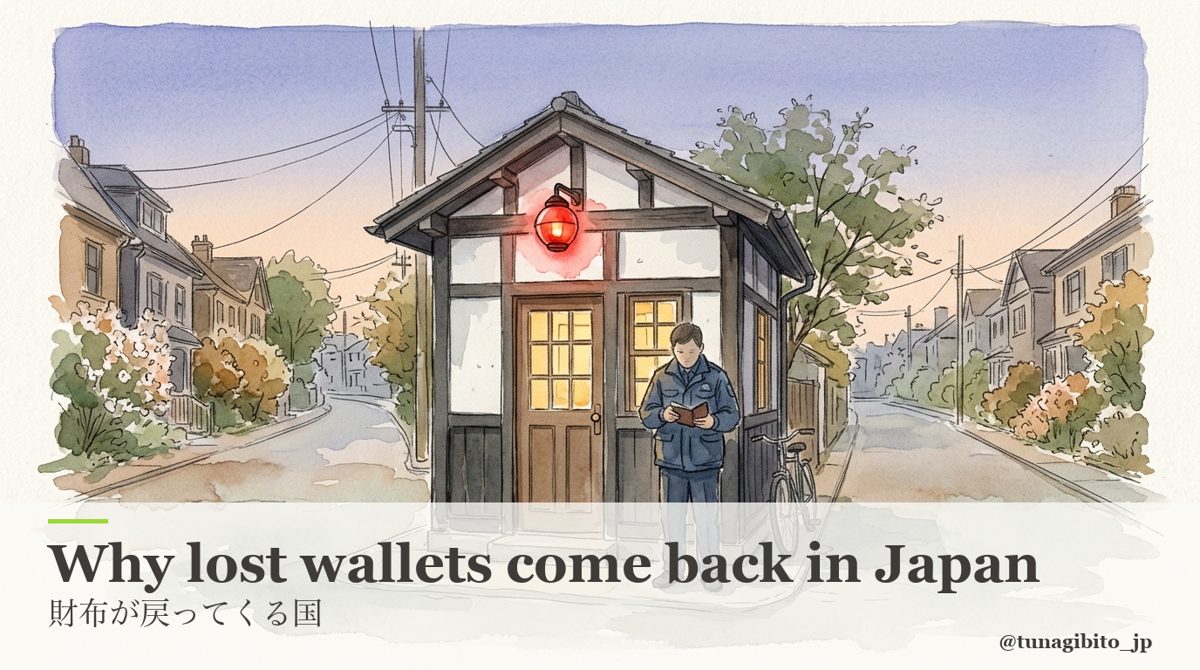
Visitors to Japan are often surprised when a lost wallet comes back with the cash still inside.
Kōban (交番) — a small neighborhood police box. There are about 6,000 of them across the country, staffed by around 48,000 officers. When you find something, the koban is where you take it first.
Many children are taught to hand in even a 10-yen coin. If the owner appears, the finder can ask for 5 to 20 percent of the money as thanks. If no one claims it within 3 months, all of it goes to the finder.
In 2018, Tokyo police reported that 65 percent of lost wallets and 83 percent of lost phones made it back to their owners.
In Japan, many of us grew up with the koban on the corner.
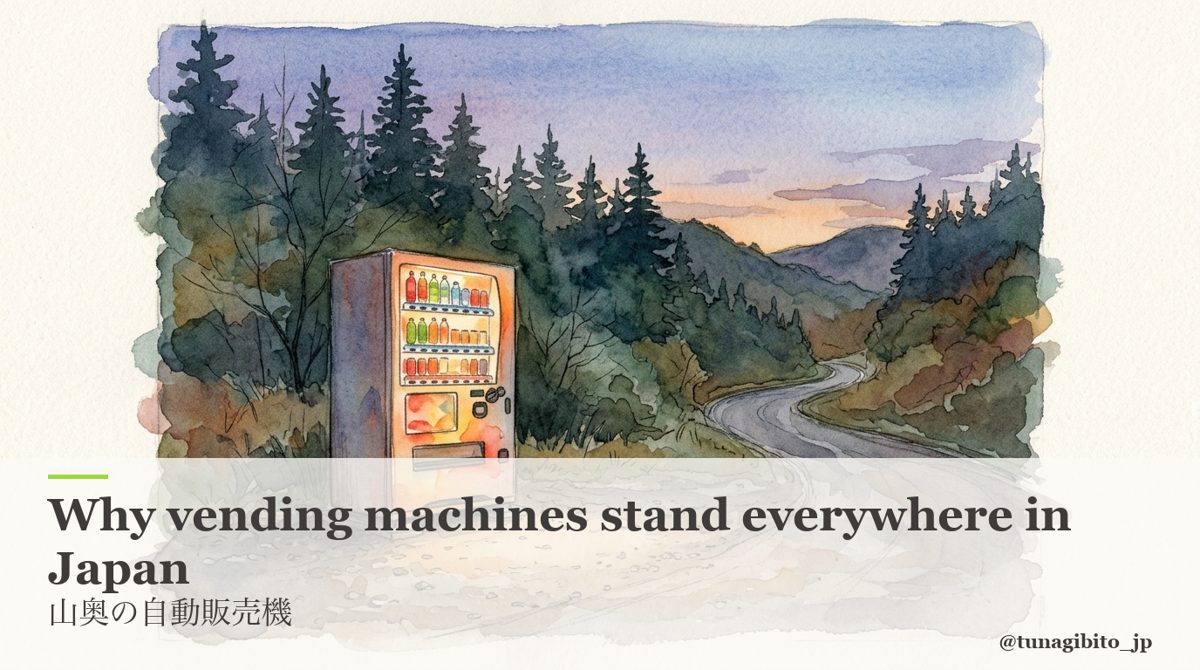
Visitors to Japan often find a glowing vending machine where they least expect one, on a quiet country road or deep in the mountains.
Jidō hanbaiki (自動販売機) — literally "automatic selling machine." Japan is said to have about 4.15 million of them, roughly one for every 30 people, and more than 2 million of those sell drinks.
They can stand in remote places because theft and vandalism are rare. Other reasons often given are a shrinking population, which makes staff hard to find, and the shortage of land.
In Japan, many of us walk past these machines every day without a second thought. A machine standing alone on a dark road simply looks ordinary to us.
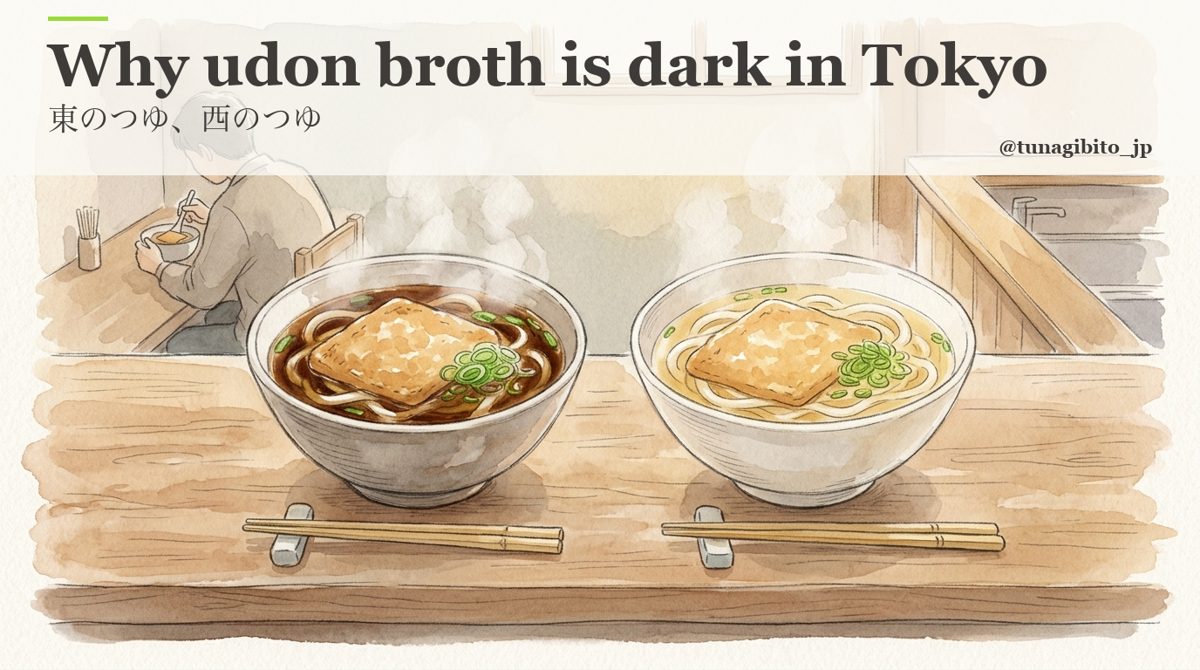
The same bowl of kitsune udon can look almost black in Tokyo and nearly clear in Osaka.
The difference starts with dashi, the stock under almost everything in Japanese cooking. In the Kanto region around Tokyo, it leans on katsuobushi (dried bonito flakes) and dark soy sauce, so the broth is deep in color and strong in taste.
In the Kansai region around Osaka, the base is kombu kelp, often joined by small dried sardines, and it is finished with light soy sauce. The color stays pale.
People say "soba in the east, udon in the west." Kitsune udon, topped with fried tofu, is said to have been born in Osaka.
In Japan, many of us have a quiet opinion about which broth tastes like home.
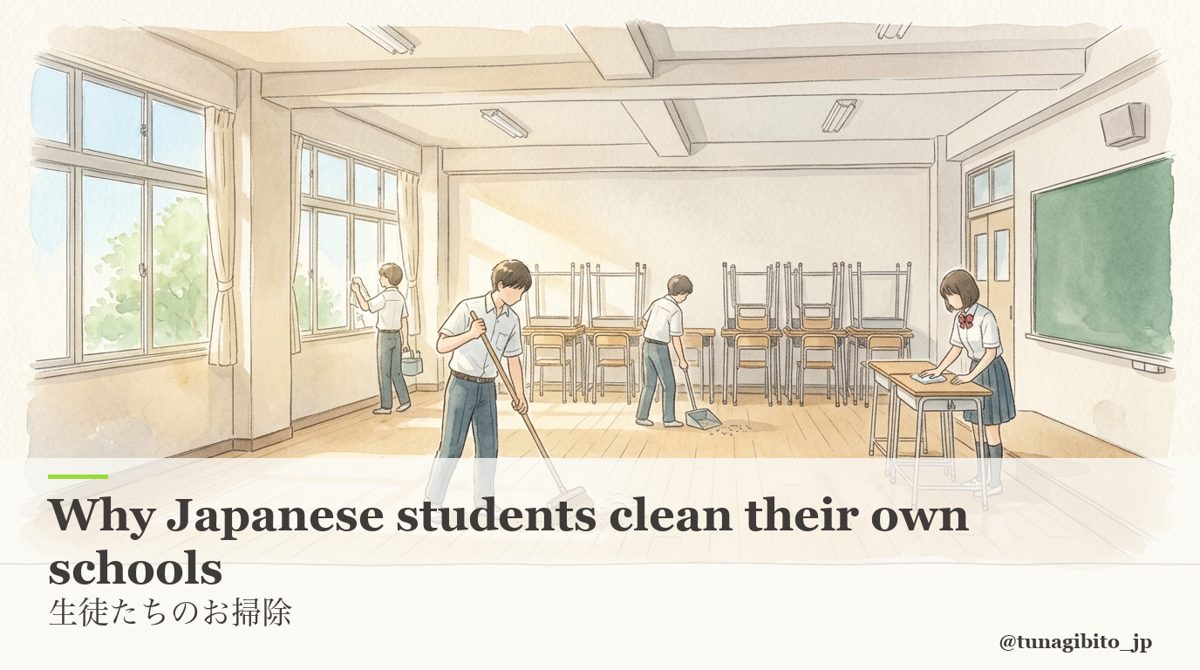
Visitors to Japan are often surprised that students clean their own schools, right down to the toilets.
Osōji (お掃除) — cleaning, here the daily school cleaning time.
At a set time, the whole school stops. From elementary to high school, students clean classrooms, hallways and their assigned areas. It is neither a punishment nor an optional activity. It is part of school life.
Teachers say it builds confidence and prepares students for adulthood. One voice put it simply: if you have to clean it up, you learn not to make the mess. The aim is responsibility and respect for shared spaces, not filling a staffing gap.
In Japan, many of us carry that habit into adult life without noticing.
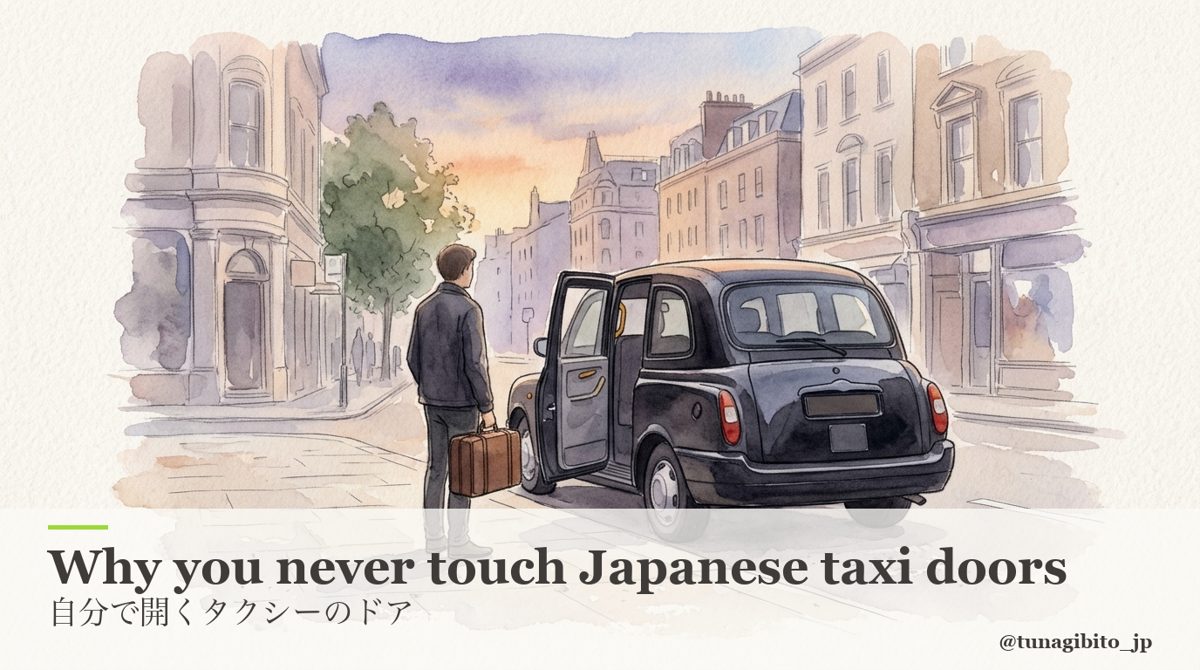
Visitors to Japan often reach for the door of a taxi, then watch it swing open on its own.
Jidō doa (自動ドア) — an automatic door. Here, the rear door the driver opens and closes from the front seat.
So you wait for it to open when you get in. When you arrive, you stay seated until it opens again. Pulling it shut by hand can strain the mechanism, so it is best left alone.
In Japan, many of us never touch a taxi door at all. We wait, and it opens.
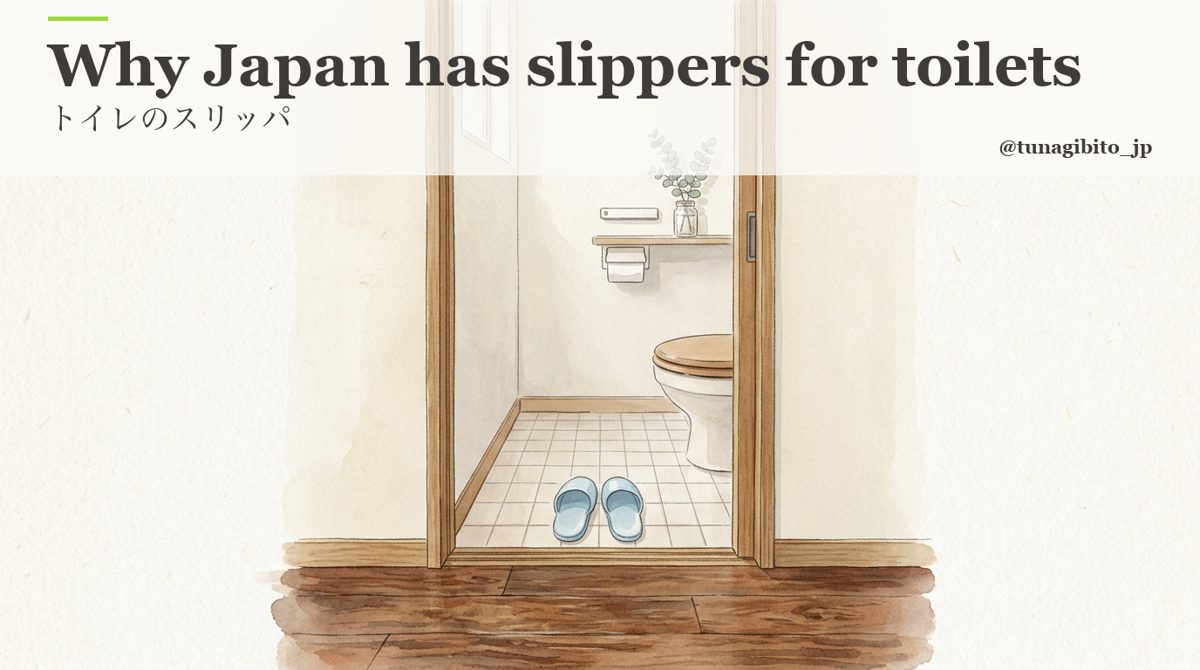
Visitors to Japan often open a restroom door in a home or restaurant and find a second pair of slippers waiting inside.
Toire surippa (トイレスリッパ) — slippers worn only in the toilet room.
They keep your indoor slippers from getting wet or dirty. They also act as a quiet signal. If the pair is missing from the doorway, someone is inside.
The custom is often explained by older homes, where the toilet floor was bare earth. Changing slippers kept the soil from being carried into the house.
The classic mistake for guests is walking back to the room still wearing them.
In Japan, many of us change at the door without thinking. It marks where one space ends and another begins.
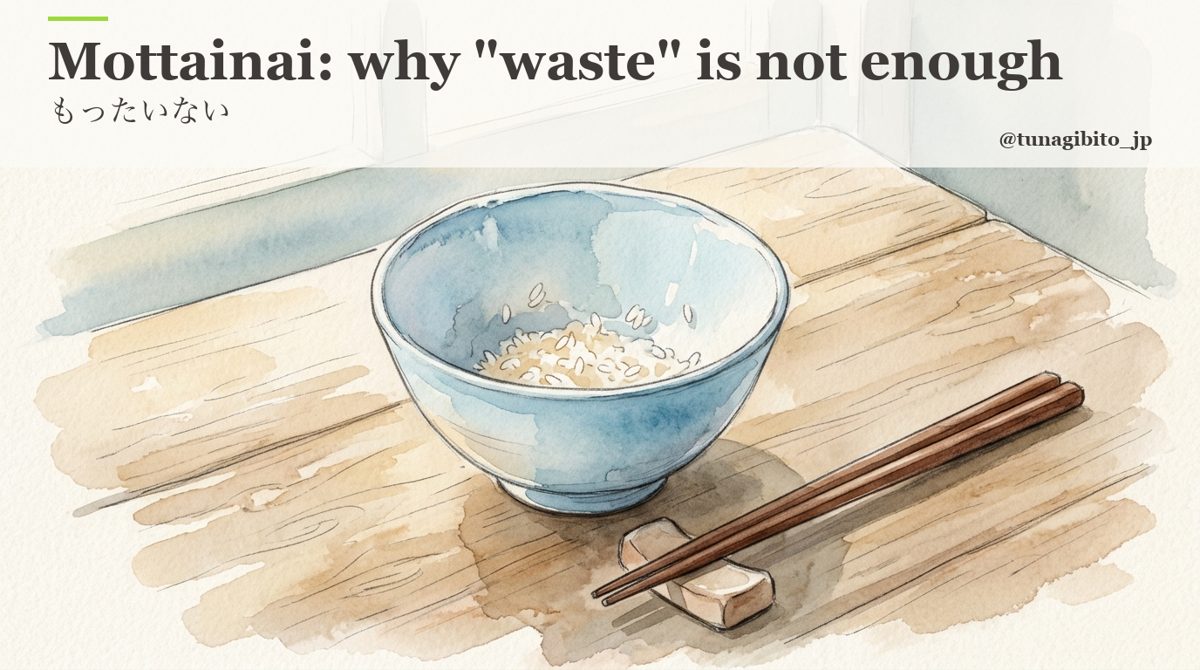
Have you ever thrown away half a meal and felt a small pang you could not name?
Mottainai (もったいない) — often translated as "What a waste!"
The word joins mottai, the true weight or dignity of a thing, with nai, "without." An old dictionary is said to record it in the 13th century.
It can carry regret over something wasted. It can also mean "this is too fine for me," when you are given more than you feel you deserve. One English word cannot hold both.
Its roots are usually linked to Buddhist ideas of thrift and caring for things. Some say the Shinto view that even objects have a spirit shaped it as well.
In Japan, many of us say it over a few grains of rice left in the bowl.
日本語訳
【日本のことば】もったいない
食事を半分捨てたとき、名前のつけられない小さな胸の痛みを感じたことはありませんか。
もったいない(mottainai)。英語では「What a waste!(なんて無駄な)」とよく訳されます。
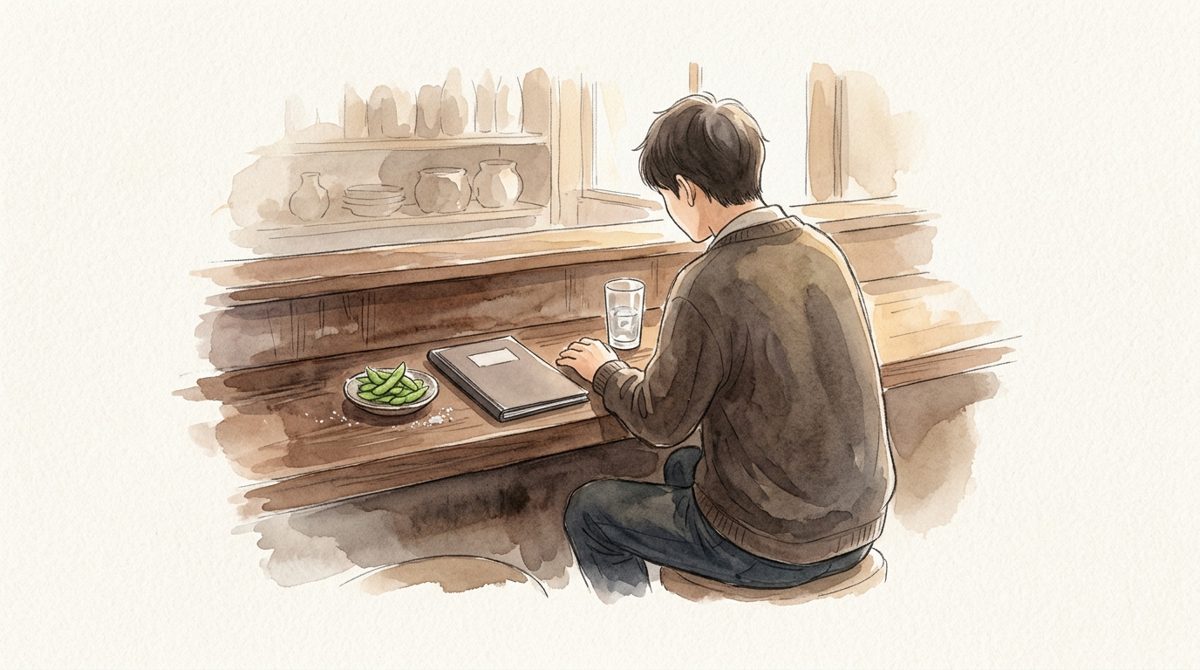
Visitors to Japan often sit down at an izakaya and find a small dish in front of them before they have opened the menu.
Otoshi (お通し) — a small starter brought to your seat on arrival.
It might be tofu, edamame, pickles or a few nuts. Then it appears on the bill, usually around 300 yen a person, and first-time travelers are puzzled. The question comes up online again and again.
English-language guides trace it to the Edo period, when sake shops served whatever snacks they had on hand. Today it is often described as standing in for a seating or service charge, in a country without tipping.
In Japan, many of us barely notice it. The little dish is simply how the evening begins.
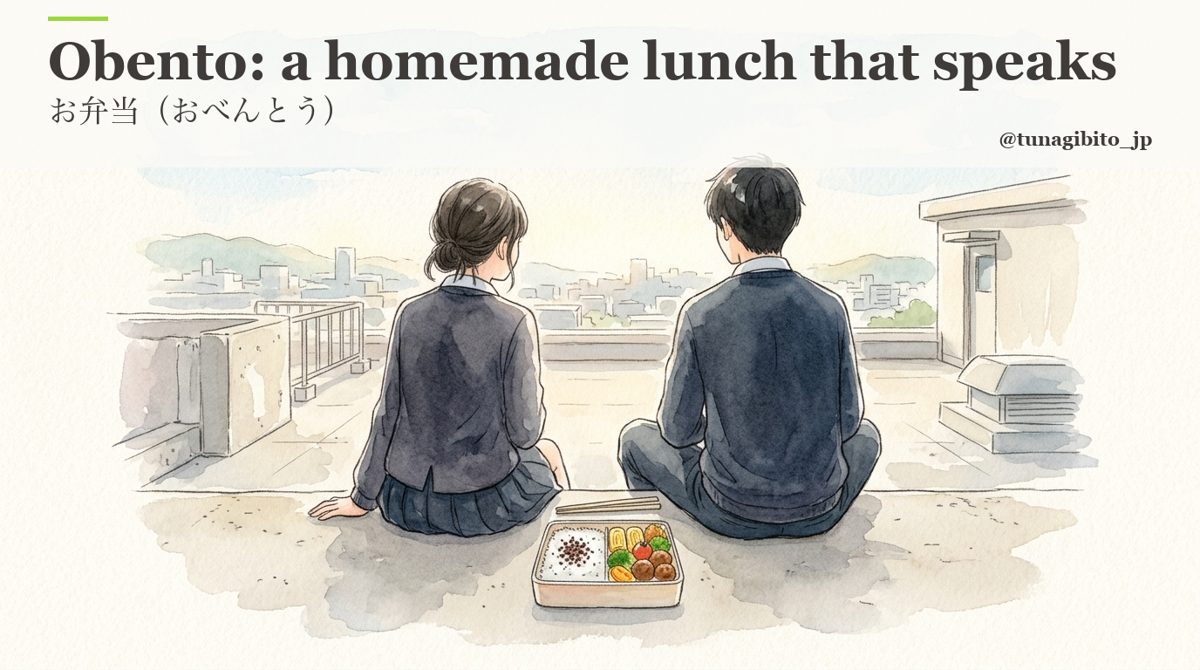
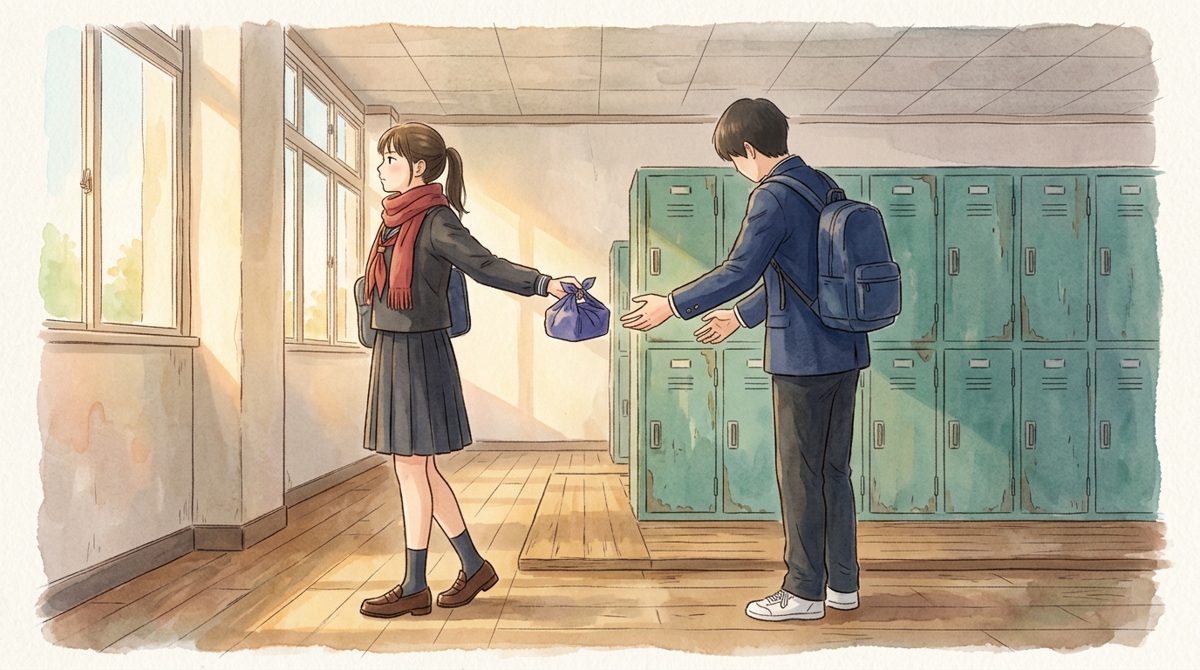
Visitors to Japan often notice the care packed into a lunch box, rice at its center, small dishes fitted around it.
Obentō (お弁当) — a packed meal for one, carried from home.
Many families make one for someone close, so the box is a daily meal and a small message at once.
In anime and manga, characters eating or sharing a bento is a familiar scene, and a homemade one can show kindness or affection without a word. Some people even make kyaraben, lunches decorated to look like characters.
In Japan, many of us know the feeling of opening the lid and sensing someone thought of us that morning.
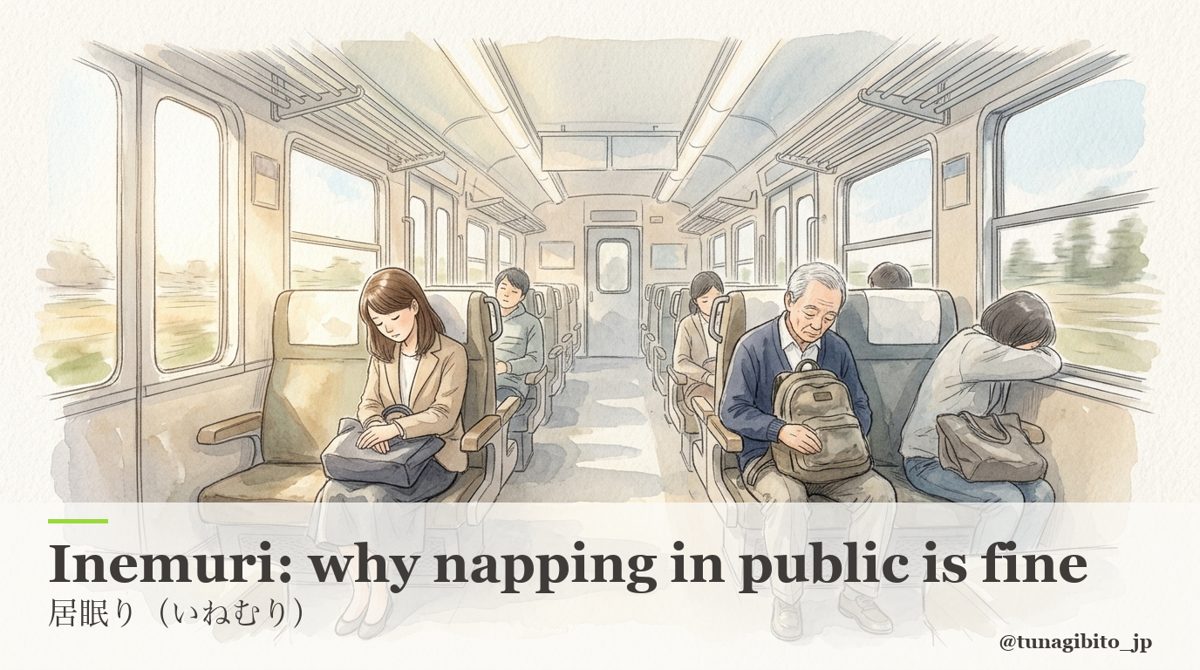
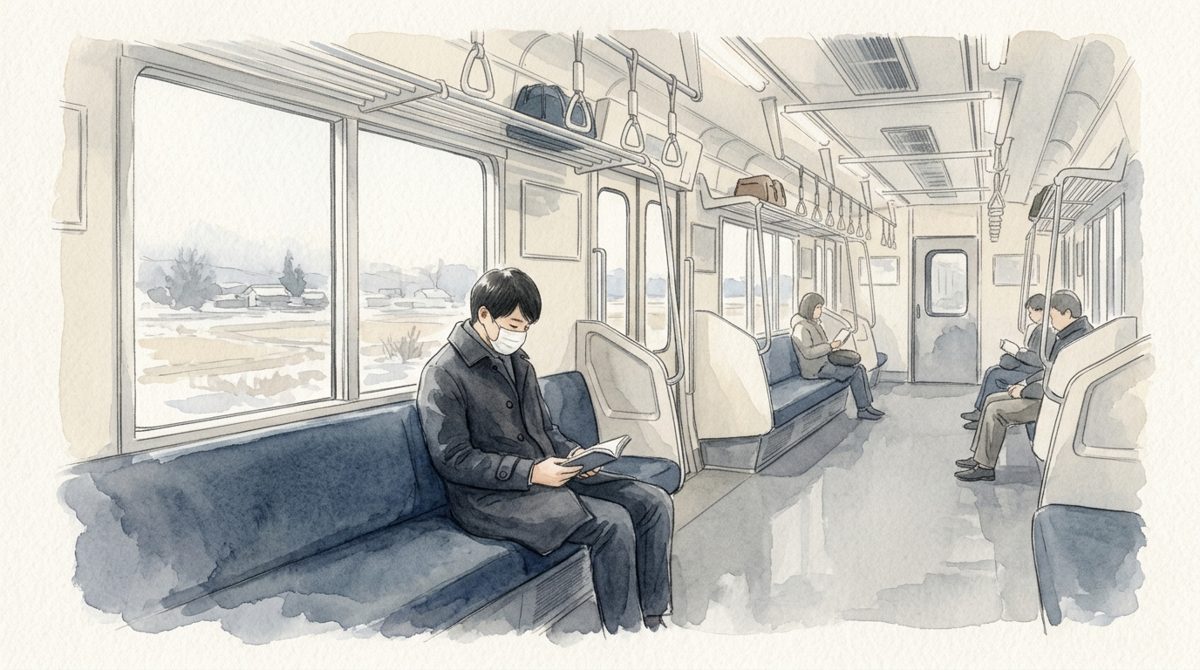
Visitors to Japan often notice people asleep on the train, heads tilted, bags held close. Nobody seems to mind.
Inemuri (居眠り) — usually translated as "dozing," though it is often explained as sleeping while still being present.
English-language guides say the habit goes back at least 1,000 years. Two reasons come up. Many people sleep little; a 2015 government survey found 39.5% of adults slept under six hours a day. And public places are safe enough to close your eyes.
There is an unspoken rule, too. Sleep compactly, and take up no extra space.
In Japan, many of us see a sleeping stranger as someone resting between one place and the next.
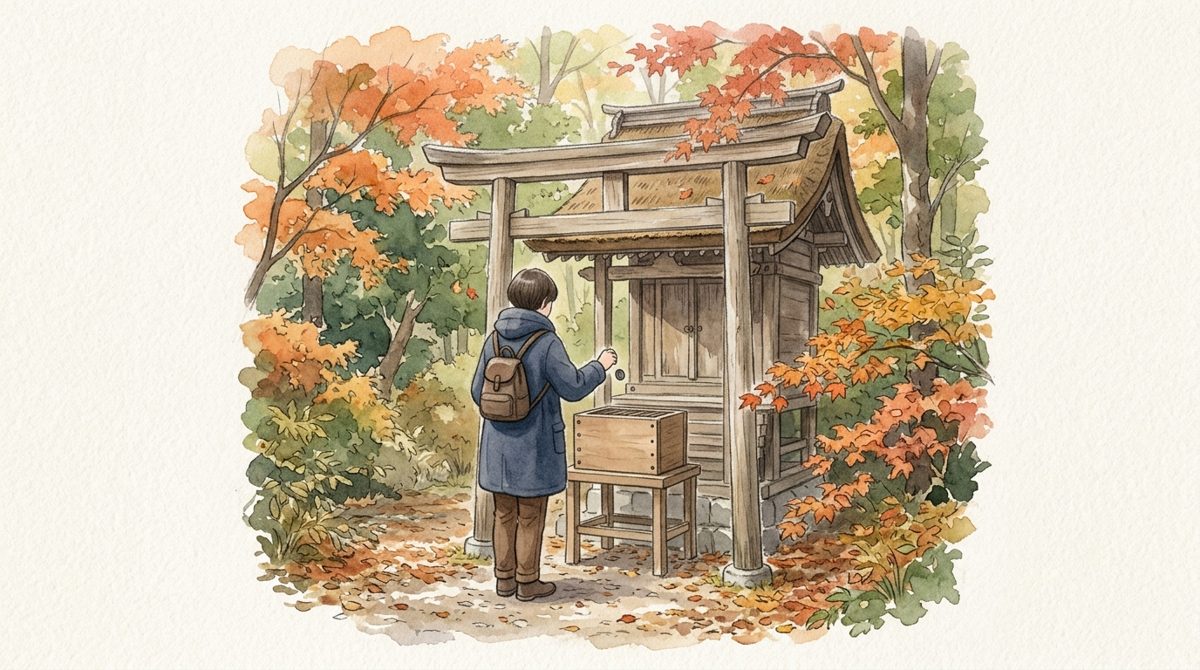
Visitors at Japanese shrines often notice people dropping the same coin into the offering box: a 5-yen coin. Why that one?
Goen (ご縁) — a bond or connection. Osaisen (お賽銭) is the offering itself.
Five yen is read "go-en," which sounds the same as goen. So the coin is seen as a lucky one for tying good bonds.
Offerings were not always coins. People once scattered rice, or wrapped rice in white paper. The offering is said to express thanks to the gods and to clear away the impurities we gather. Many people still pick their amount by wordplay.
In Japan, many of us look for a 5-yen coin in our wallets before a shrine visit, almost without thinking.
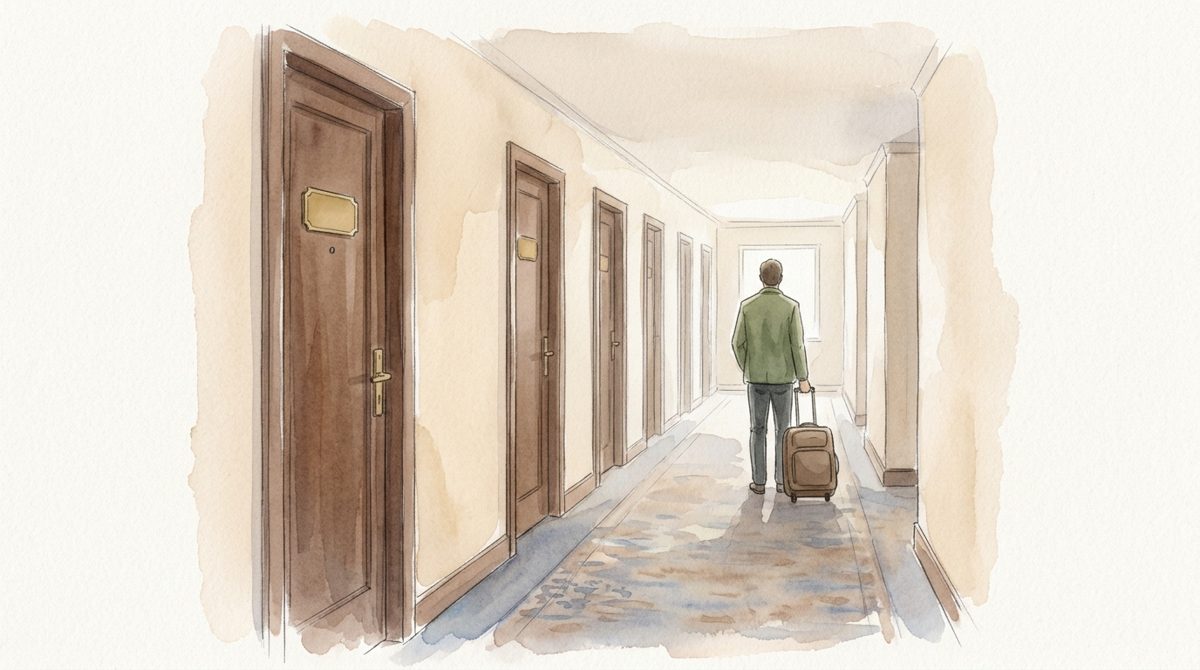
Visitors staying at some hotels in Japan notice something odd about the room numbers: there is no room 4.
Imikazu (忌み数) — unlucky numbers.
In Japanese, 4 can be read "shi," the same sound as the word for death. 9 can be read "ku," which also means suffering. So some hotels, apartment buildings and hospitals skip rooms 4 and 9. Some buildings have no 4th or 9th floor. The number 49 is avoided too, as it can suggest "suffering from beginning to end."
Science has moved on, but many people still care, and the buildings follow their guests.
I think many of us in Japan do not truly believe a number brings bad luck. We still feel a little easier in room 5.
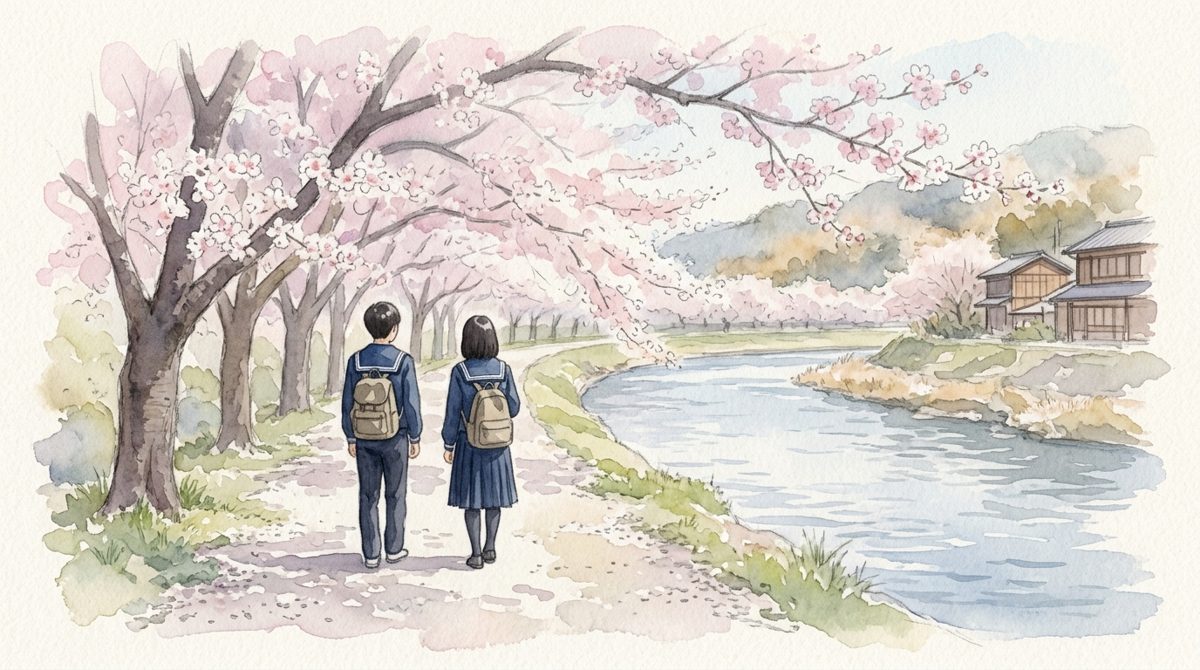
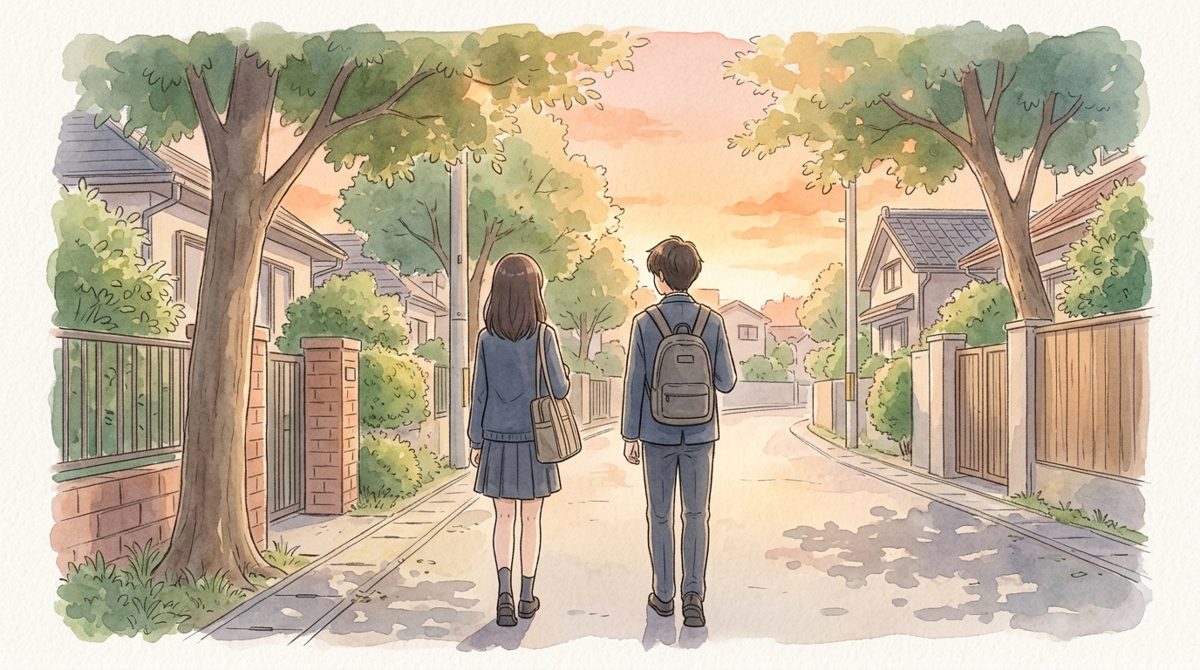
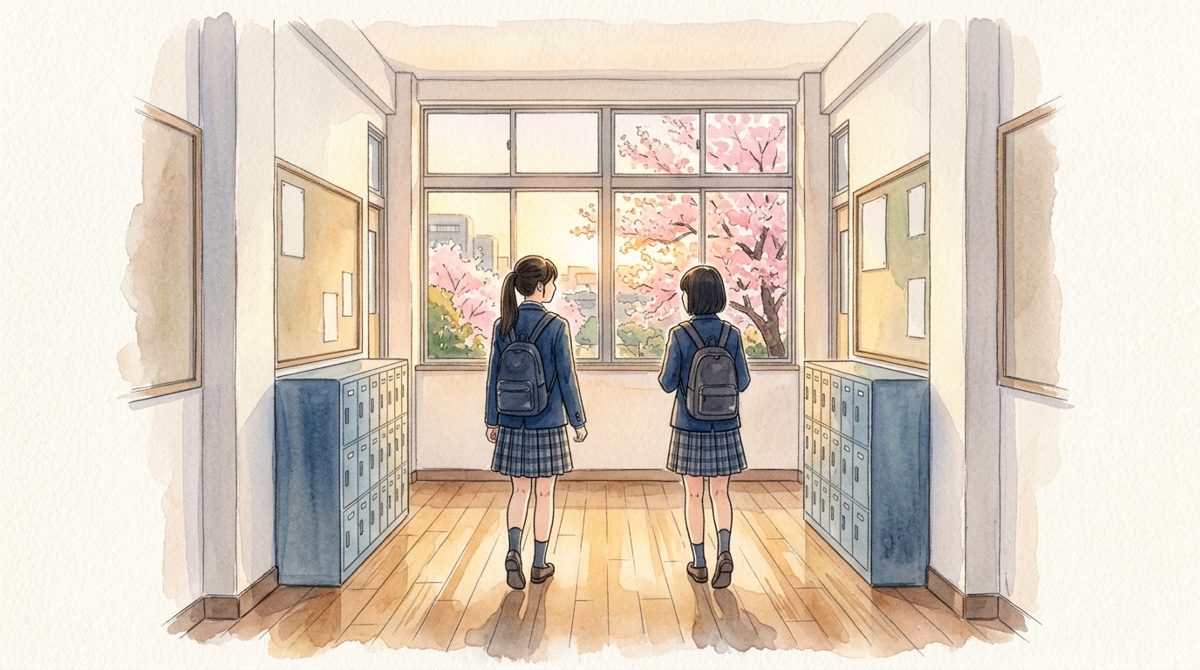
Watch almost any school anime and you will see it: a schoolgirl in something close to a navy uniform. It looks like a costume, but it is based on something real.
Sera-fuku (セーラー服) — the sailor-style uniform.
Its roots go back to the uniforms of the British Royal Navy in the 19th century. When girls' schools began in the Meiji era, students mostly wore kimono. Western-style clothing spread in the mid-Taisho era.
Around 1920, girls' schools in Fukuoka, Nagoya and Kyoto adopted the sailor uniform, and it spread across the country. Which school was first is debated. Kyoto's was a one-piece dress; Fukuoka's separate top and skirt is closer to today's form.
For many of us in Japan, the sailor collar simply means school days.
Places in Japan | 信仰の対象と芸術の源泉 (shinko no taisho to geijutsu no gensen)
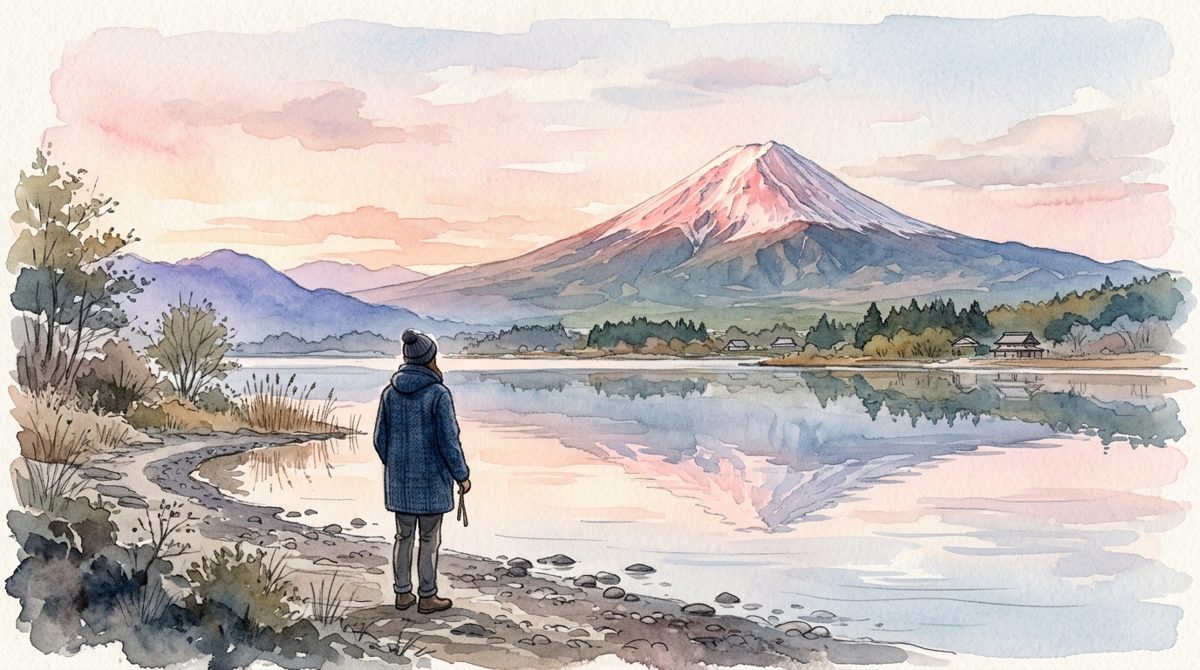
Mount Fuji is a volcano. So why is it a UNESCO Cultural Site and not a Natural one?
Shinko no taisho to geijutsu no gensen — "an object of worship and a source of art."
That is part of the official title. Fuji was listed on June 22, 2013. The campaign first aimed for Natural Site status, but the mountain was dropped as a candidate in Japan's own review.
What carried it was culture. Fuji has long been worshipped as a sacred mountain, and it became a favorite subject of ukiyo-e woodblock prints.
I think many of us in Japan still pause a little when Fuji comes into view, even on an ordinary day.
日本語訳
【日本の名所】信仰の対象と芸術の源泉 (shinko no taisho to geijutsu no gensen)
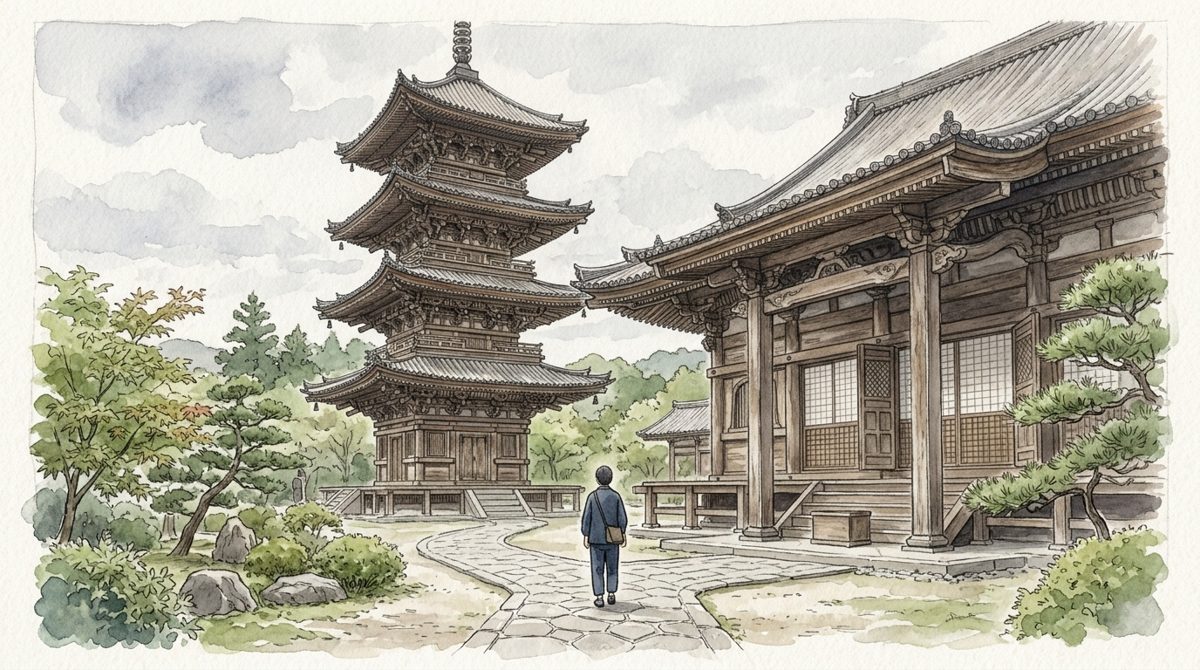
You stand at Horyu-ji in Nara, and the wooden buildings in front of you are more than 1,300 years old. How does wood last that long?
Hinoki (檜) — Japanese cypress.
Work on Horyu-ji began in the early seventh century. Studies of when its timber was felled show the buildings are at least 1,300 years old. In 1993, the Buddhist monuments in the Horyu-ji area became Japan's first World Cultural Heritage site.
The wood is hinoki, a strong timber. It is said that wood keeps gaining strength for 100 to 200 years after it is cut, then changes little for about a thousand years.
In Japan, we sometimes speak of wood as something that keeps living after it is cut. Horyu-ji makes that sound less like a figure of speech.
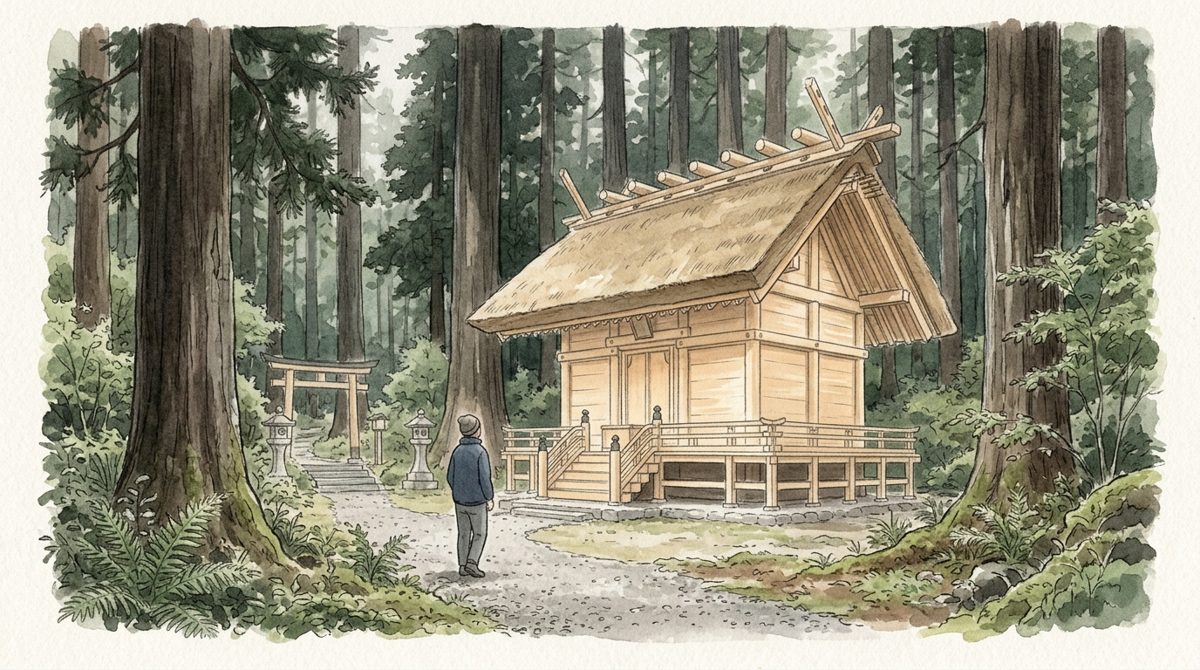
Many visitors come to Ise Grand Shrine expecting something ancient. Then they learn its main buildings are rebuilt every 20 years. So is it ancient or new?
Shikinen sengu (式年遷宮) — the rebuilding of the shrine at fixed intervals.
A new sanctuary is built and the deity is moved into it. It is said to express the renewal of the divine spirit and of the nation's life. Why 20 years? There is no settled answer. The shrine describes it as a sensible span for passing skills to the next generation. Others point to the life of a thatched roof.
Beneath it lies tokowaka (常若), the idea of staying ever young.
In Japan, I think we often feel that something stays old because it keeps being made new.
A deep Japanese red can be written with the character for "swallow," the bird. The bird seems to have little to do with it.
Enji — a dark red.
The word came from China and was written several ways with the same sound. One theory links it to Mount Yanzhi, known for safflower. The word itself may have Central Asian roots.
The red came from safflower, and later also from lac and cochineal insects.
In Japan, we use the word without asking why a bird sits inside it.
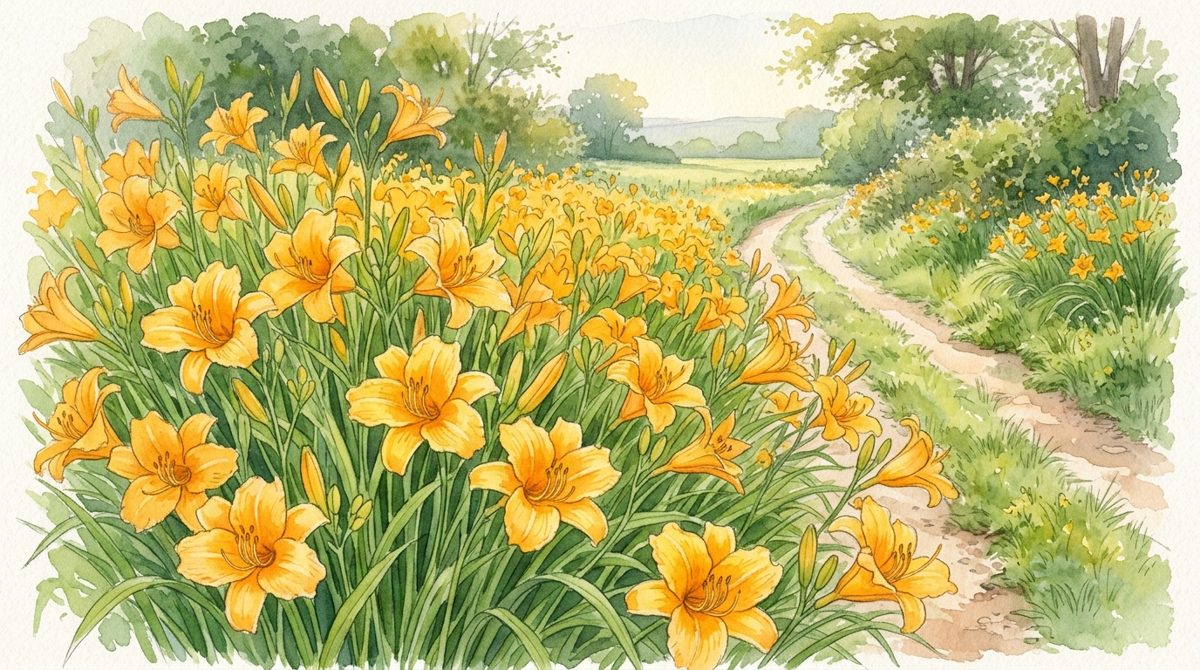
Visitors to Japan may see a bright orange on old fabrics and never guess it is named after a flower they know: the daylily.
Kanzo-iro (萱草色) — the orange of the kanzo flower.
Kanzo is a plant in the Hemerocallis group, and the color is a light, yellowish orange. One way to dye it was to lay madder or safflower red over gardenia yellow. Another used sappanwood with alum.
The name has been in use since the Heian period and appears in The Tale of Genji. The same plant is also called wasuregusa, "the grass of forgetting." So one flower lives on in Japanese twice, once as a color and once as another name.
Many of us in Japan know the color without ever connecting it to the flower.
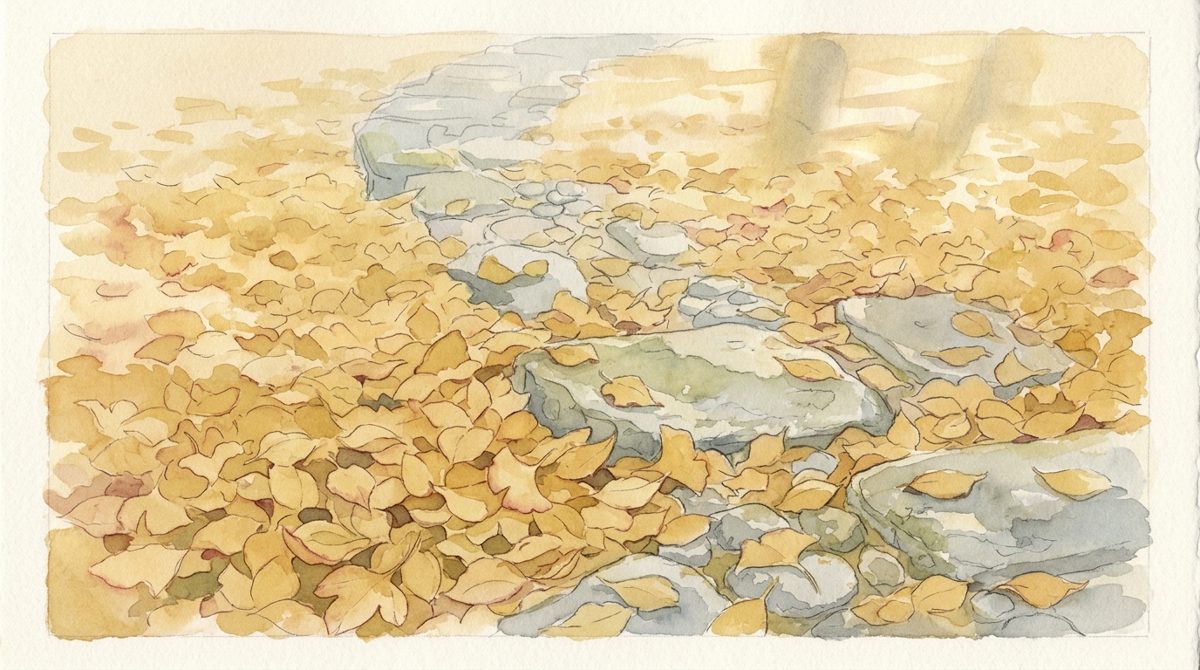
One traditional Japanese color has a name that means "yellow decaying leaves." It sounds gloomy at first.
Kikuchiba — the yellow of fallen leaves.
Kuchiba means decaying leaves. Dyers mixed gardenia yellow with madder or safflower red. A reddish shade was akakuchiba. A yellow one was kikuchiba.
Kuchiba appears in tenth-century writings such as the Engishiki. In layered court dress, kikuchiba also named a yellow-on-yellow combination worn in autumn.
I think many of us in Japan still find a quiet beauty in leaves after they fall.
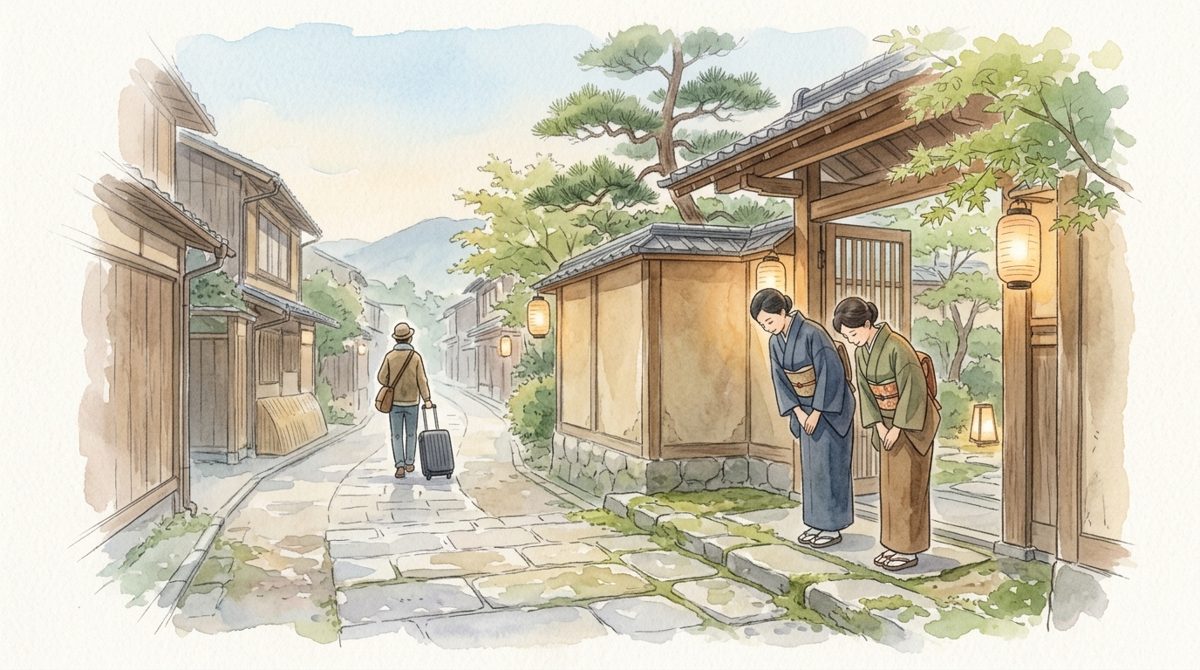
You leave a ryokan, look back from the road, and the staff are still bowing.
Omiokuri (お見送り), "seeing someone off."
At inns and shops, staff may come out to the entrance and keep waving and bowing until the guest is out of sight. It says thank you for coming, and please come again. It is described as hospitality carried all the way to the last moment.
A proverb is often quoted here. Sode furiau mo tashō no en. Even brushing sleeves with a passerby is a tie worth valuing.
In Japan, many of us feel a goodbye does not end when the door closes. It ends when the other person can no longer be seen.
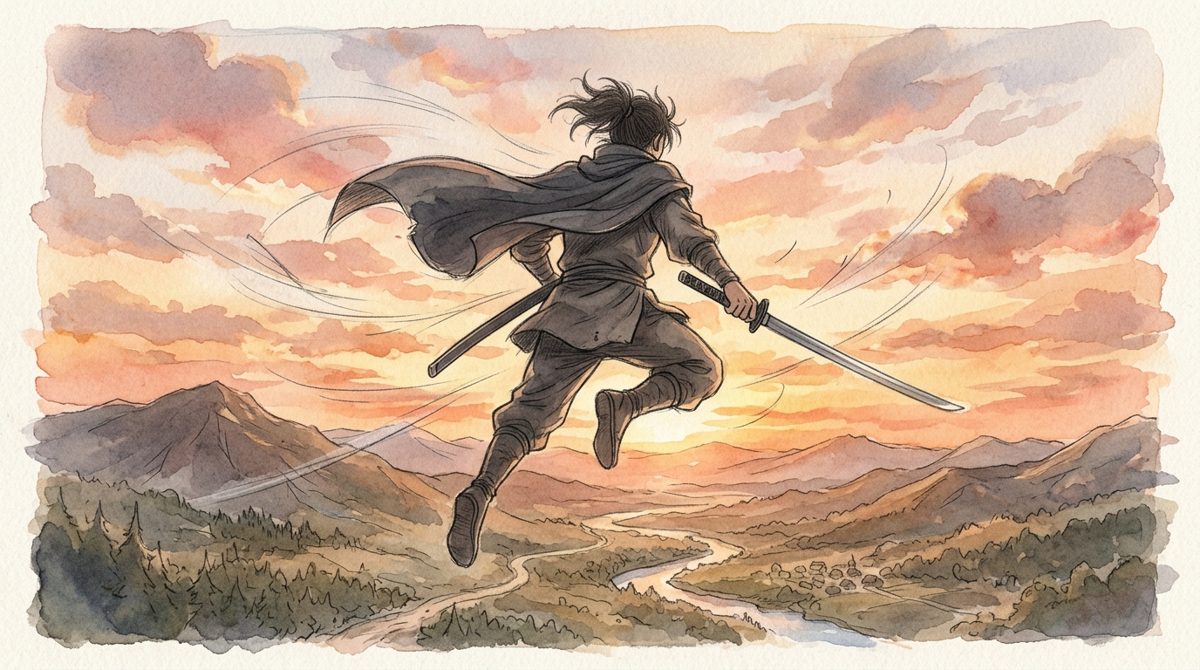
In anime, right before the big move, the character shouts its name. Why?
Nanori (名乗り), roughly "announcing yourself."
Japan has an old tradition of declaring your name before a fight, and one theory traces the shouting back to samurai announcing their names and skills. In manga, a shouted move name can also help readers follow the order of panels and the direction of motion. Another theory points to robot anime of the 1970s and 80s, where calling out the robot's name helped the show stick and sold toys.
No single reason is settled.
In Japan, many of us also say steps out loud. Shisa-koshō, "pointing and calling," is widely practiced, and first-aid training has you voice each step.
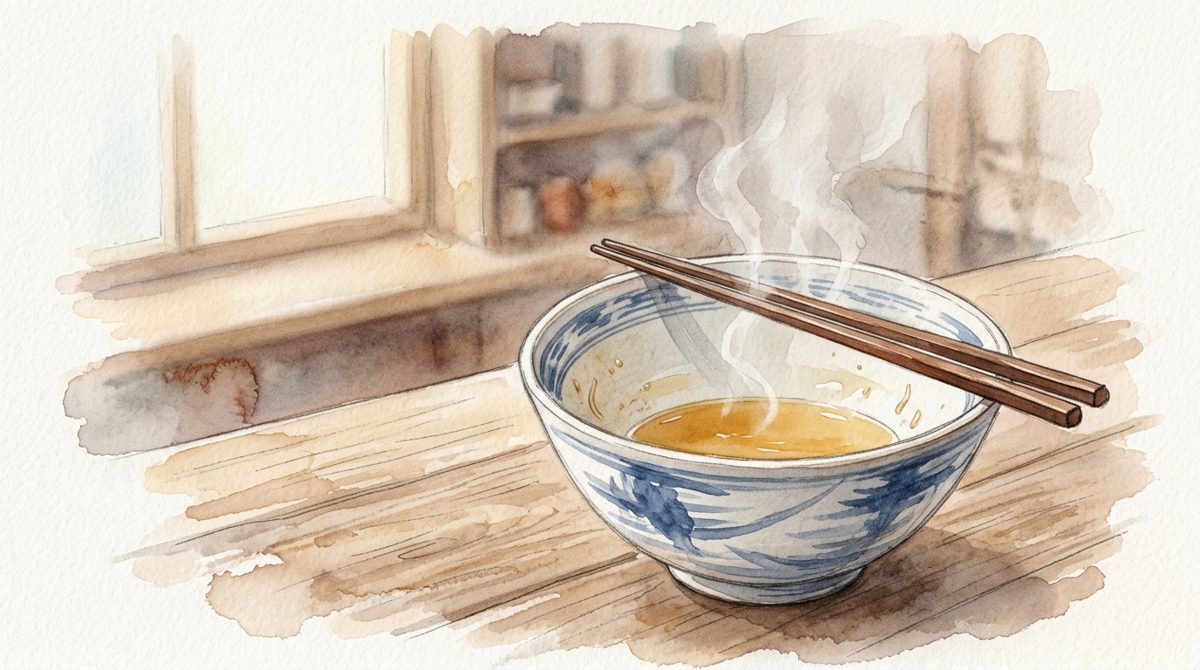
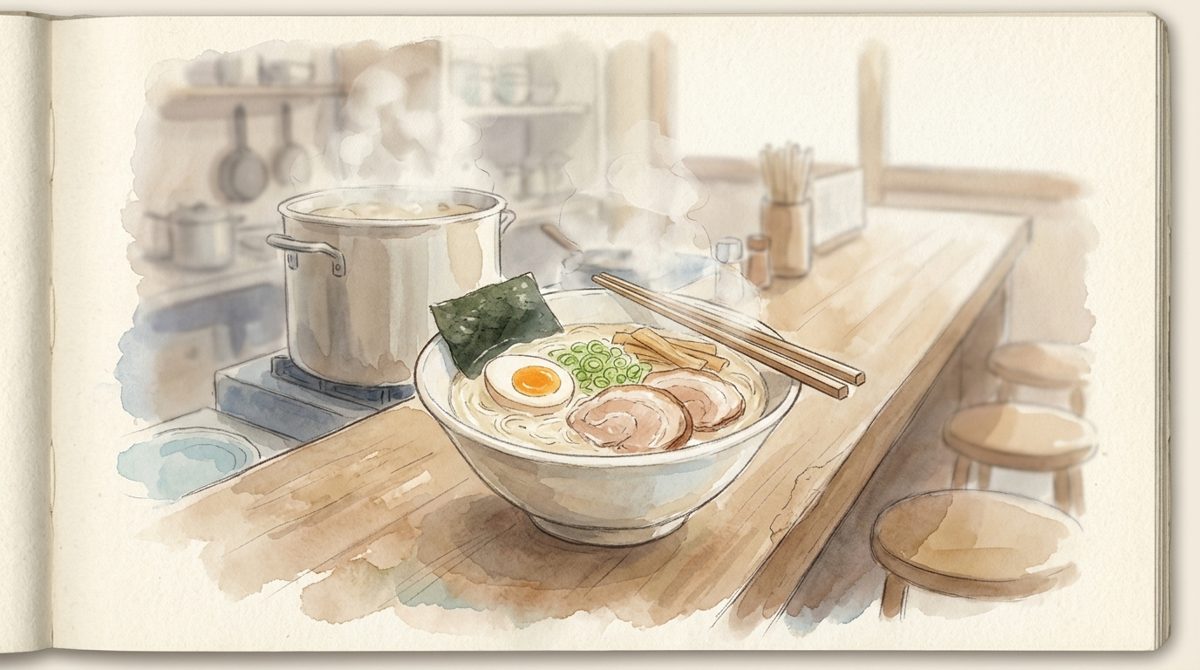
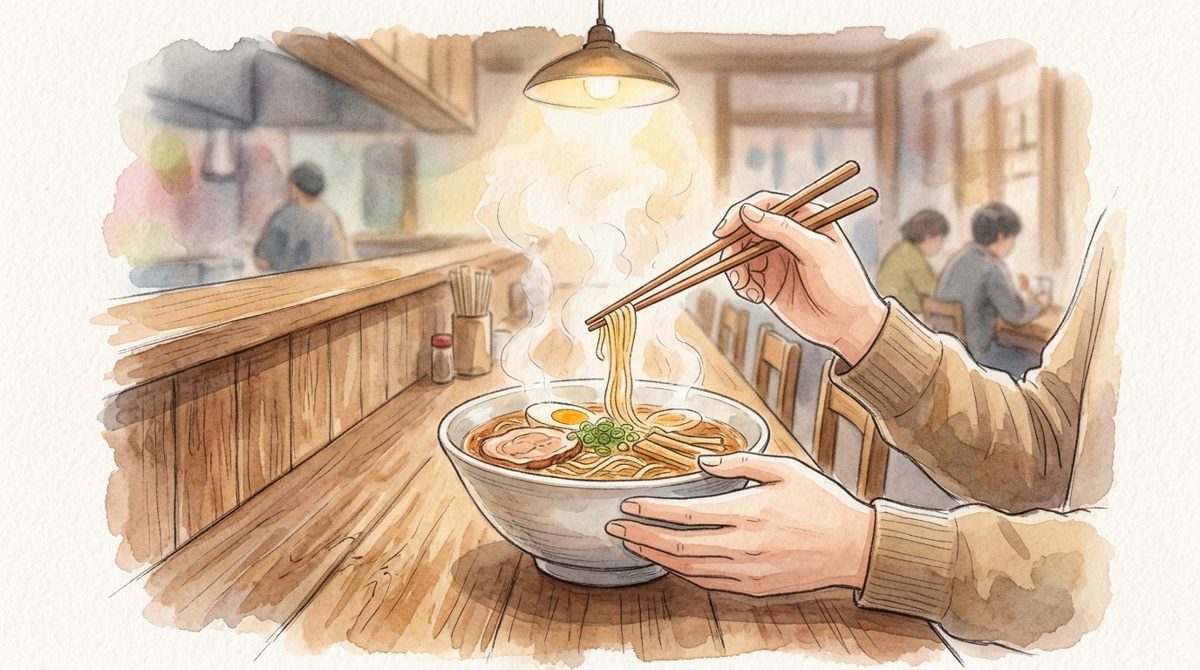
The noodles are gone, and there is still soup in the bowl. Are you supposed to drink it?
Sūpu (スープ), the soup of a bowl of ramen.
Japanese table manners have no rule that says you must finish it, and leaving some is not considered rude. Some drink every drop because they do not want to waste what the cook worked hard on. Others leave it because it is salty and they are watching their health.
Both sides have their reasons, and neither is the one right answer.
In Japan, many of us decide quietly, depending on the bowl and on how we feel that day.
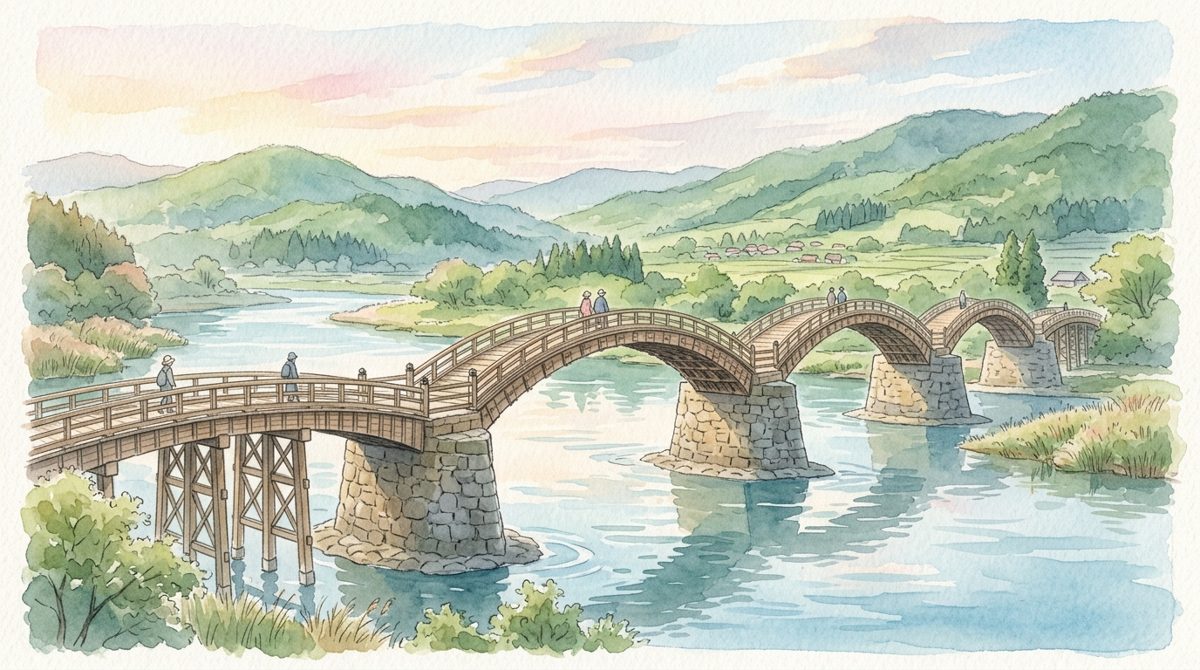
Five wooden arches cross the Nishiki River in Iwakuni. They began as an answer to floods.
Kintaikyō (錦帯橋), roughly "brocade sash bridge."
From around 1600, bridges here kept washing away, and driftwood striking the piers was blamed. The third lord of Iwakuni wanted a bridge without piers. The hint was a painting of Hangzhou's West Lake, shown by a Chinese monk, with a five-arched bridge.
The first one opened in 1673 and was lost the next year, because its stone pier foundations were weak. It was rebuilt at once on stronger stone piers.
It is often said to use no nails, though some accounts mention metal bands on the arches.
In Japan, many of us like a story where the second try holds.
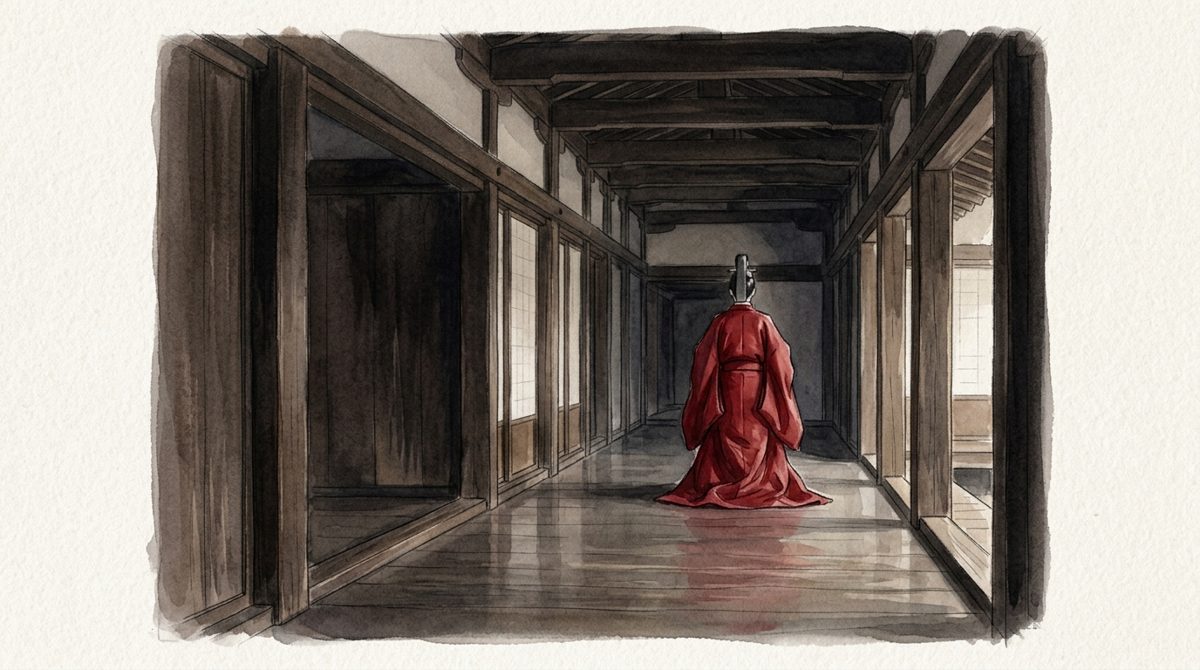
In old Japan, the color of your clothes could tell people your rank before you said a word.
Kokiake (深緋), roughly "deep scarlet."
Under the Yōrō clothing code, each court rank had its own color. The first rank wore deep purple, the fifth wore light scarlet, and deep scarlet belonged to the fourth rank.
So a deep red was not just a taste in clothing. It showed where you stood.
In Japan, many of us still feel that a color carries a sense of place. This one once carried a place in the court.
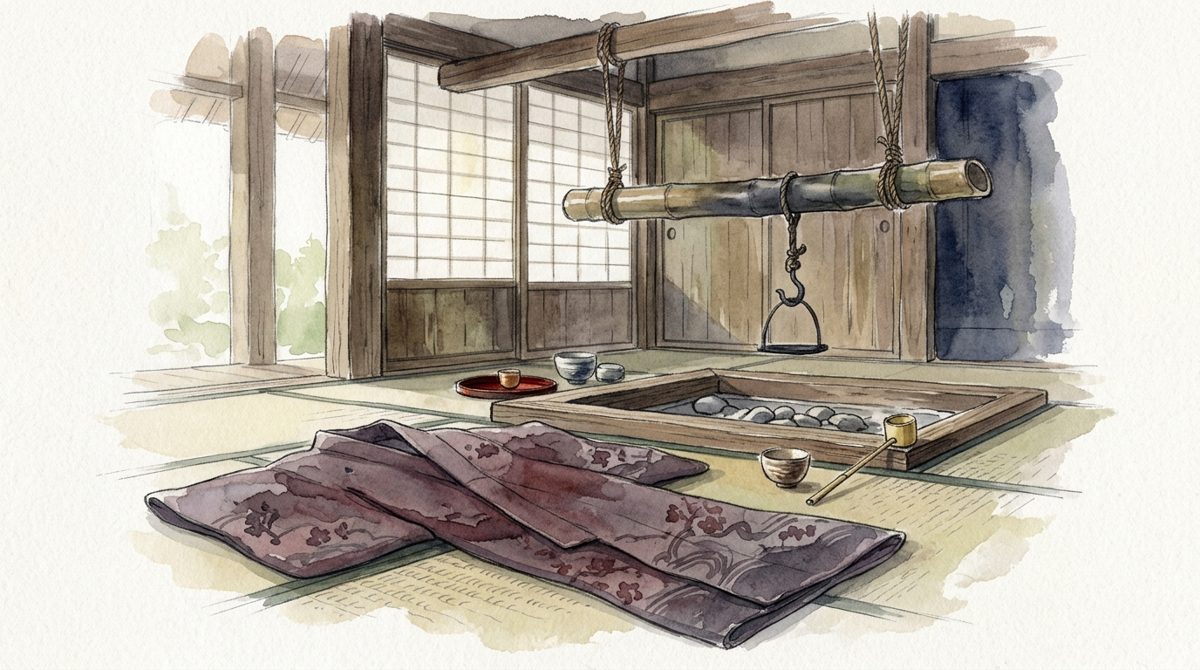
Susutake is bamboo darkened to a reddish black by years of smoke from an irori, the old sunken hearth. Add a hint of wisteria, and you get fujisusutake. It already appears as a kimono ground color in a pattern book published in 1687.
It has relatives, too. Gin-susutake is a paler version, and yanagi-susutake leans toward willow green.
In Japan, many of us grow up with names like this and never ask where they came from. Smoke and a flower, in one word.
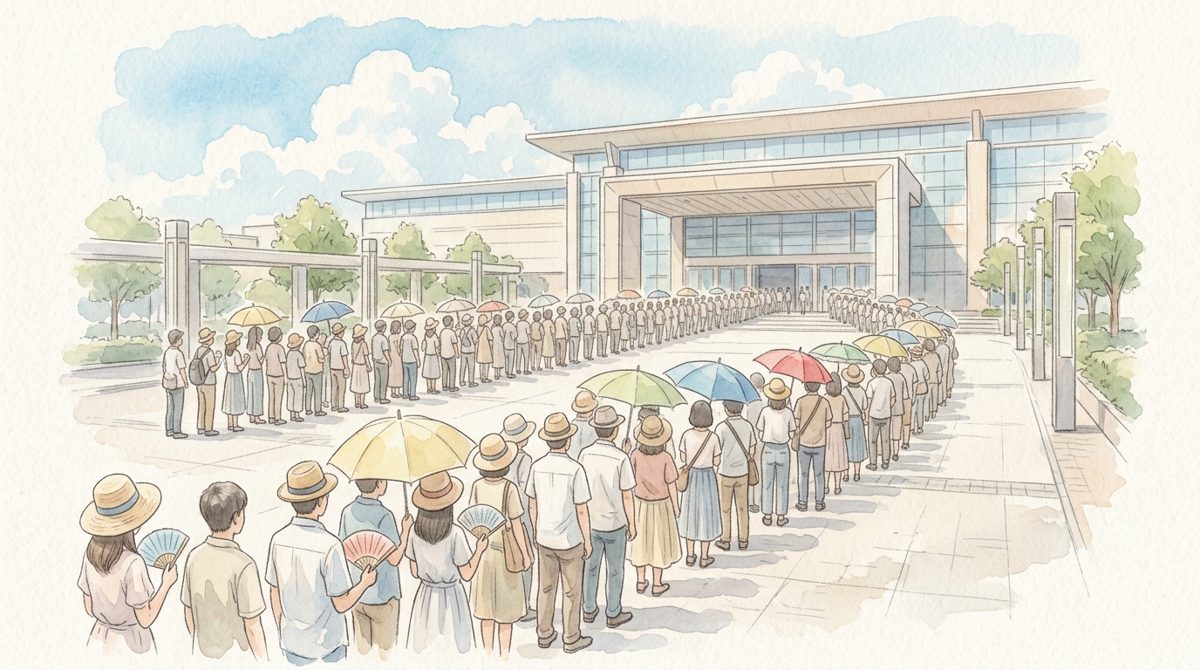
Gyoretsu means a line of people. Junban means order, or taking turns.
Lining up is one of the familiar sights of Japan. Outside a popular bakery or restaurant, a line forms and people simply wait their turn. On many train platforms, marks on the floor show where to stand for each door.
Many of us in Japan stand in line every week without anyone ever explaining why.
Visitors to Japan often notice two things. There are hardly any trash cans on the street, and the street is clean anyway.
Part of the reason is history. After the 1995 sarin gas attack on the Tokyo subway, trash bins came to be seen as places where poison gas could be hidden, and public bins at stations were removed.
So the custom is gomi no mochikaeri, taking your trash home and throwing it away there. Bins do remain where people eat right after buying, such as outside convenience stores.
Behind the habit, many point to the idea that keeping a place clean is a way of showing respect to others.
In Japan, many of us carry a small bag of our own trash home without a second thought.
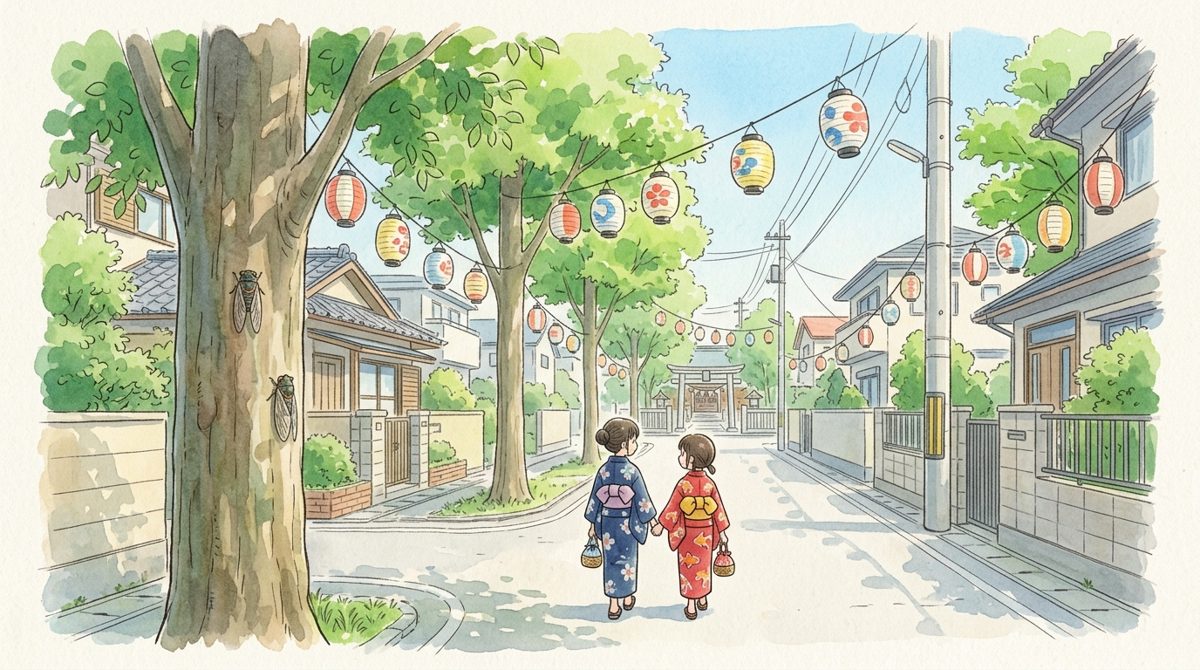
Watch a summer episode of almost any anime and you will hear it before anything happens. The steady buzz of cicadas.
Semi no koe means "the voice of the cicadas." In Japan it is the sound of summer itself. Add it to a scene and viewers know at once it is midsummer.
So it fills the classic summer episodes. Summer vacation, a natsu matsuri (summer festival), fireworks, a day at the beach. Fireworks carry their own meaning in anime, standing for fleeting beauty, memories, or feelings that are rising.
Cicadas have marked the season in Japanese culture since the age of classical literature.
For many of us who grew up in Japan, that buzz alone is enough to bring back a particular August.
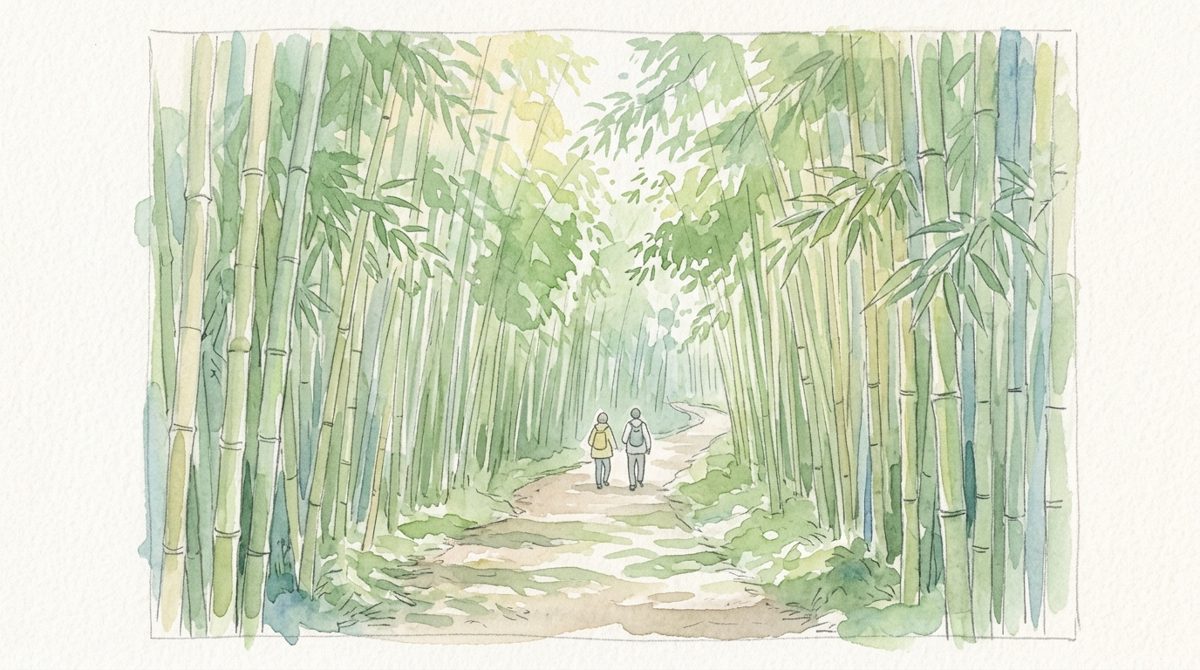
Travelers often say the same thing about the Arashiyama Bamboo Grove. The walk is short, and it is crowded. So why do so many people still go?
The path is called Chikurin no komichi, the little path through the bamboo. It is free and open 24 hours.
Part of the answer is sound. When the wind moves, the bamboo creaks and the leaves rustle. The grove was chosen as one of Japan's 100 soundscapes worth preserving.
Arashiyama itself has been a retreat for emperors and nobles since the Heian period. Many suggest going early and treating the bamboo as one part of a longer walk around the area.
In Japan, many of us remember a place like this by its sound as much as by its view.
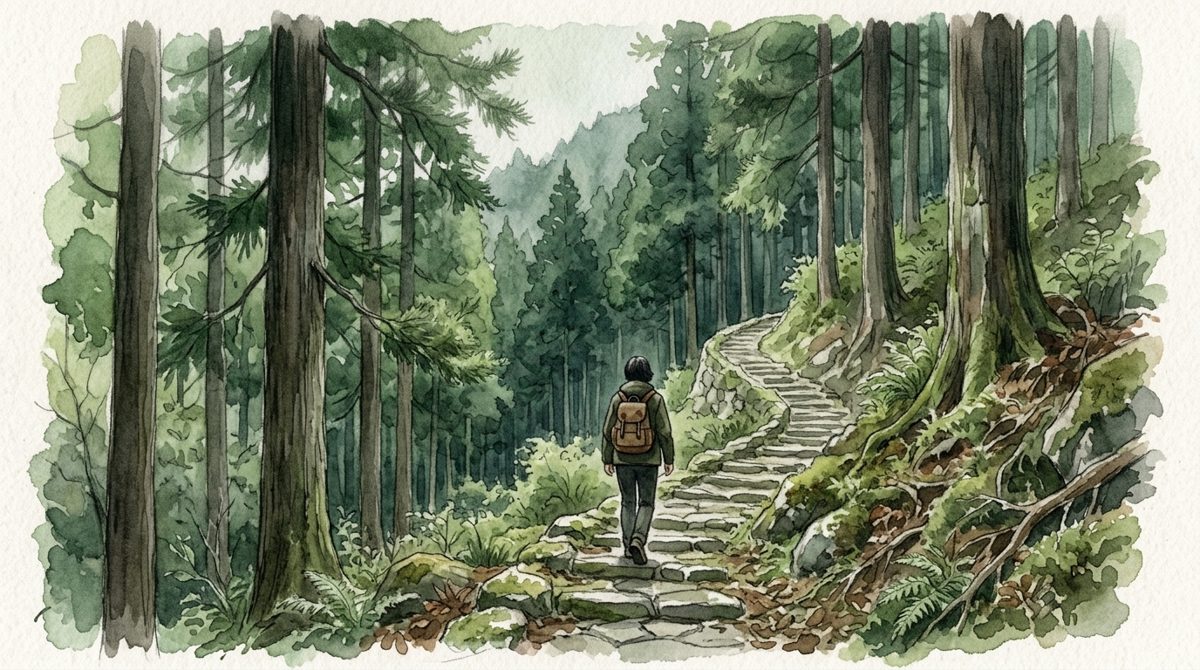
Only two pilgrimage routes are UNESCO World Heritage sites. One is the Camino de Santiago in Spain. The other runs through the mountains of Japan's Kii Peninsula.
The Kumano Kodo is a network of routes. The main one, the Nakahechi, is called the Imperial Route, because emperors and nobles walked it in the Heian period.
The routes lead to Kumano's three grand shrines, Hongu Taisha, Hayatama Taisha and Nachi Taisha. They joined the World Heritage list in 2004.
Along the Nakahechi there are inns and hot springs, so you can walk it in stages.
For many of us in Japan, Kumano is a walk we keep meaning to take.
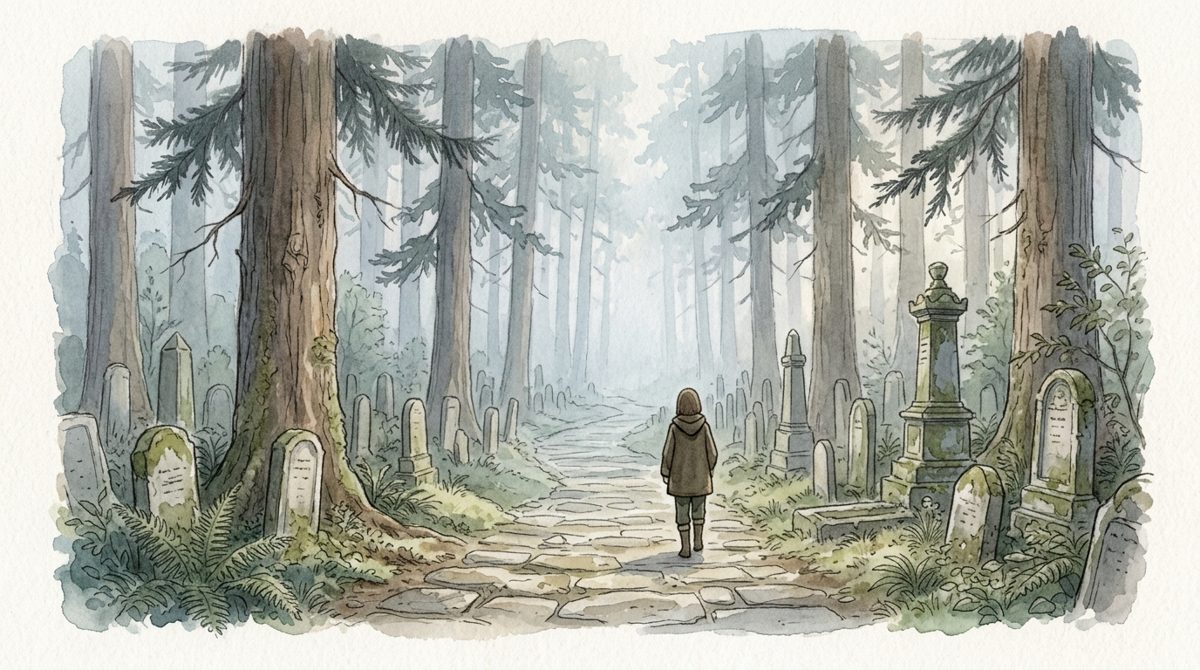
Okunoin is the holiest ground on Mount Koya. The setting helps explain why.
The approach is about 2 km long. Under tall cedars stand more than 200,000 gravestones and memorial towers.
Koyasan was opened in 816 as the center of Shingon Buddhism. Today 117 temples stand on the mountain, and it is part of a UNESCO World Heritage site.
You can also stay at a shukubo, a temple lodging. You sleep in a temple room, eat shojin ryori, the Buddhist vegetarian meal, and can join the morning service.
Many of us in Japan know the name Koyasan long before we ever make the climb.
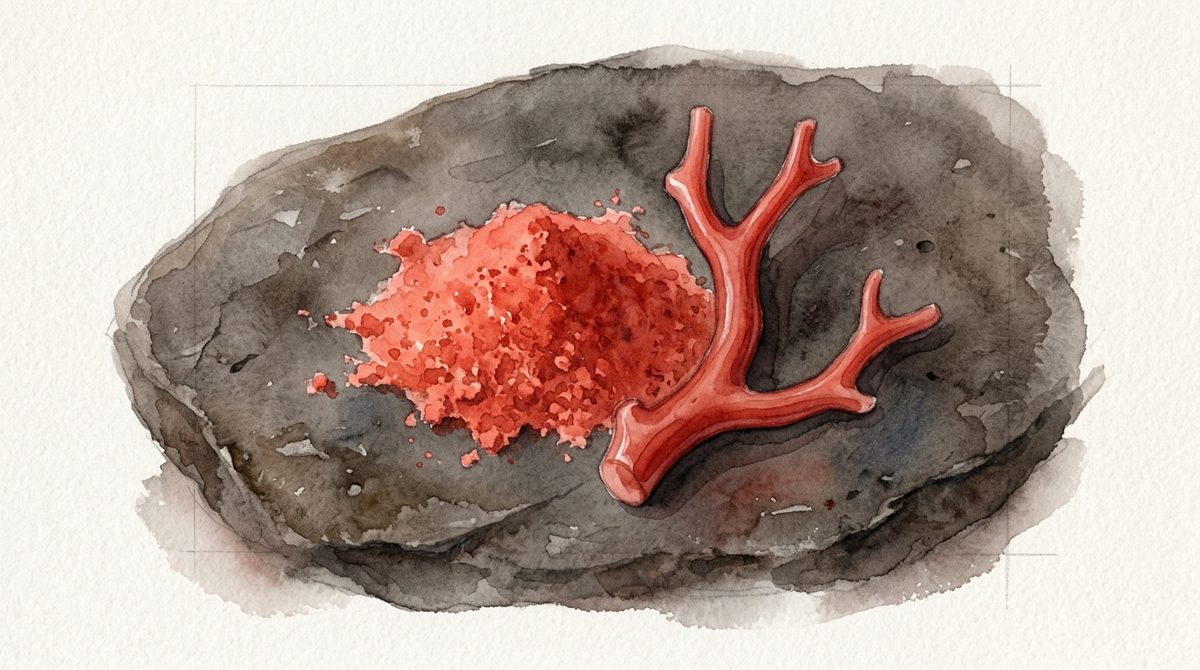
Sangoshu puts two red things into one word, sango (coral) and shu (vermilion). I could not confirm where the color name itself came from, so here are the two halves.
Shu is a red pigment made from cinnabar, a mineral of mercury sulfide. In ancient Japan, people sprinkled it over the dead and spread it on the walls and floors of burial sites. Traces have been found at sites from the Yayoi and Kofun periods.
Coral is counted among the seven treasures in some Buddhist sutras.
Many of us in Japan say the word shu all our lives without knowing it was once laid beside the dead.
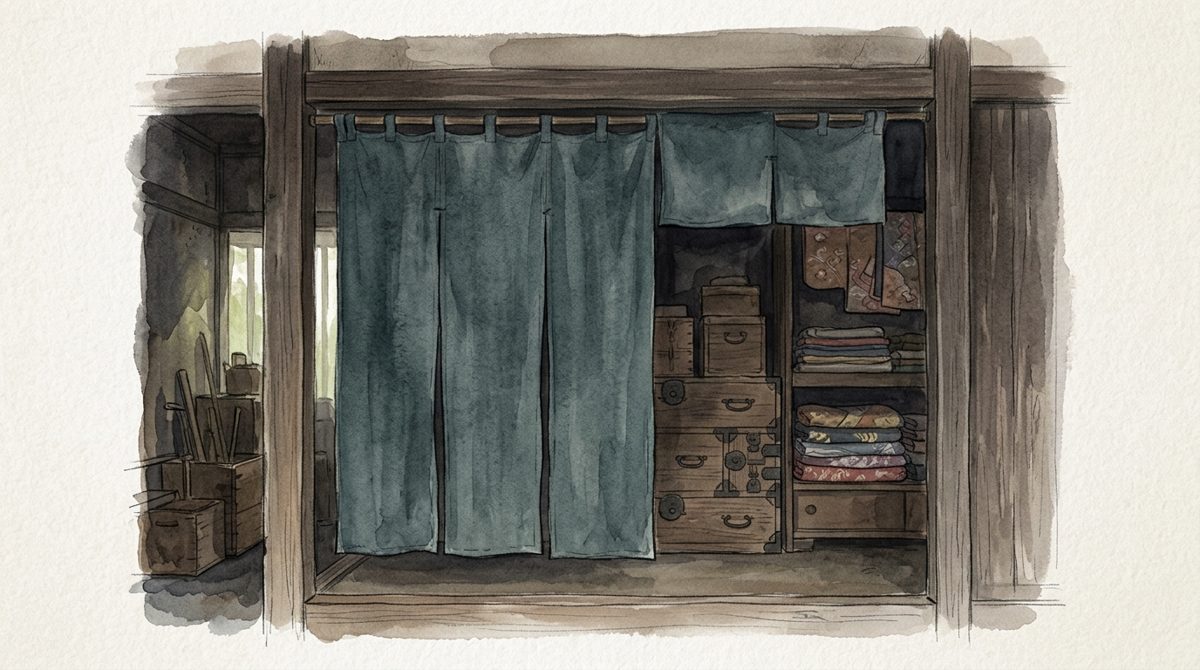
A deep, grayish blue-green in Japan is called tetsu-onando. The puzzling part is onando, which points to a storage room.
A nando is an indoor room for keeping clothes and household goods. The color name has two origin stories. One says it was the color of the curtain hung at the room's entrance. The other says it was the uniform of the onando-yaku, Edo shogunate officials who looked after the shogun's clothing and furnishings.
The polite prefix "o" in the name is thought to come from that second story.
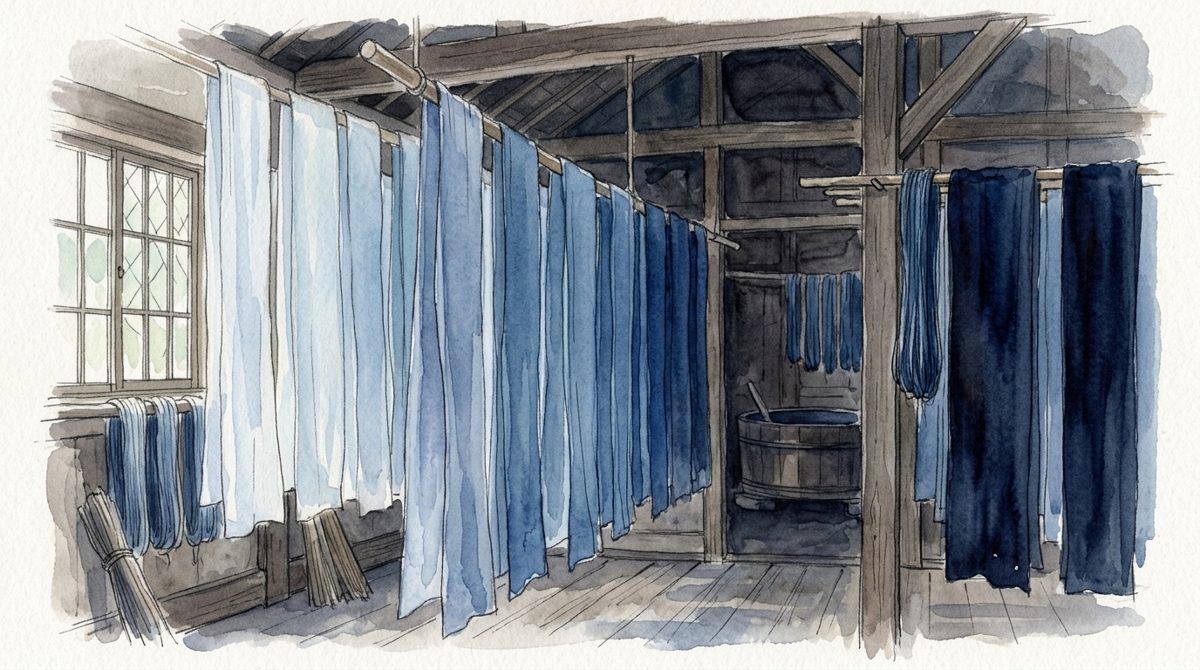
Onando-iro is an indigo-dyed blue with a touch of green. Tetsu, meaning iron, marks an even darker and grayer version.
Many of us in Japan say the name without picturing a storeroom.
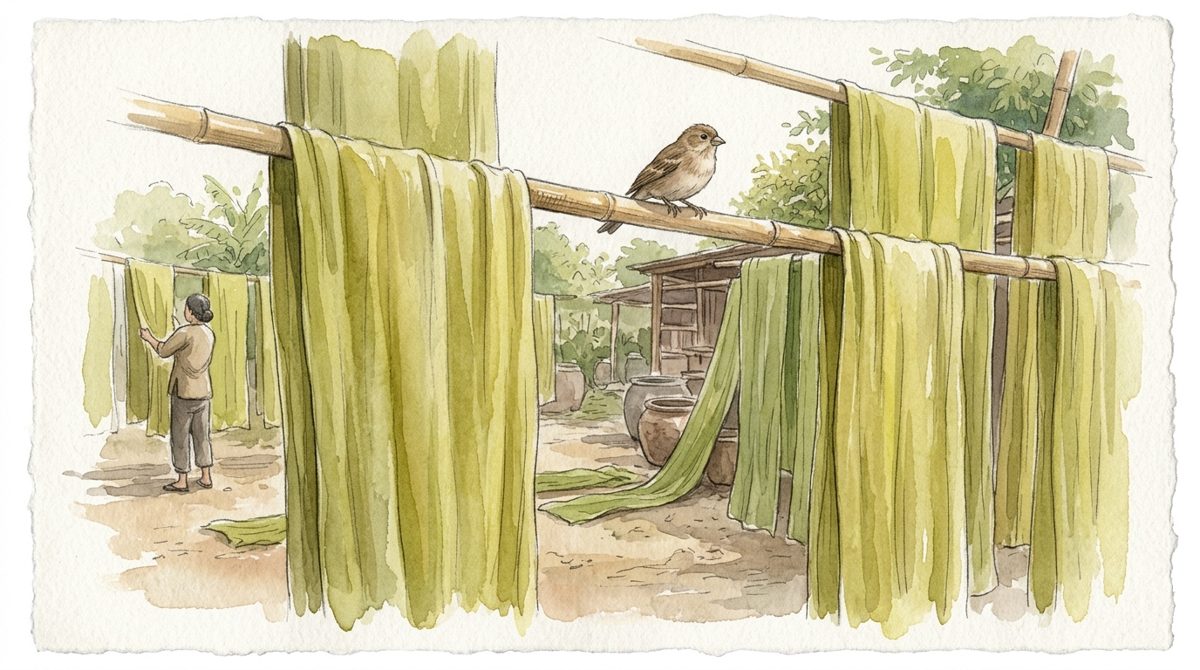
There is a soft olive green among Japan's traditional colors, and it carries the name of a small bird.
Hiwa-iro means "the color of the hiwa's feathers." The hiwa is a small finch.
Dyers made it in two ways. One was to start with a yellow dye such as kihada or kariyasu and add a little indigo. The other was to dye with kihada and fix the color with iron.
The first method shows an old idea in Japanese dyeing. Lay a little indigo over yellow, and green appears from inside the yellow. The color even has a browner relative, hiwa-cha.
In Japan, many of us use names like this for years and never stop to ask where they came from.
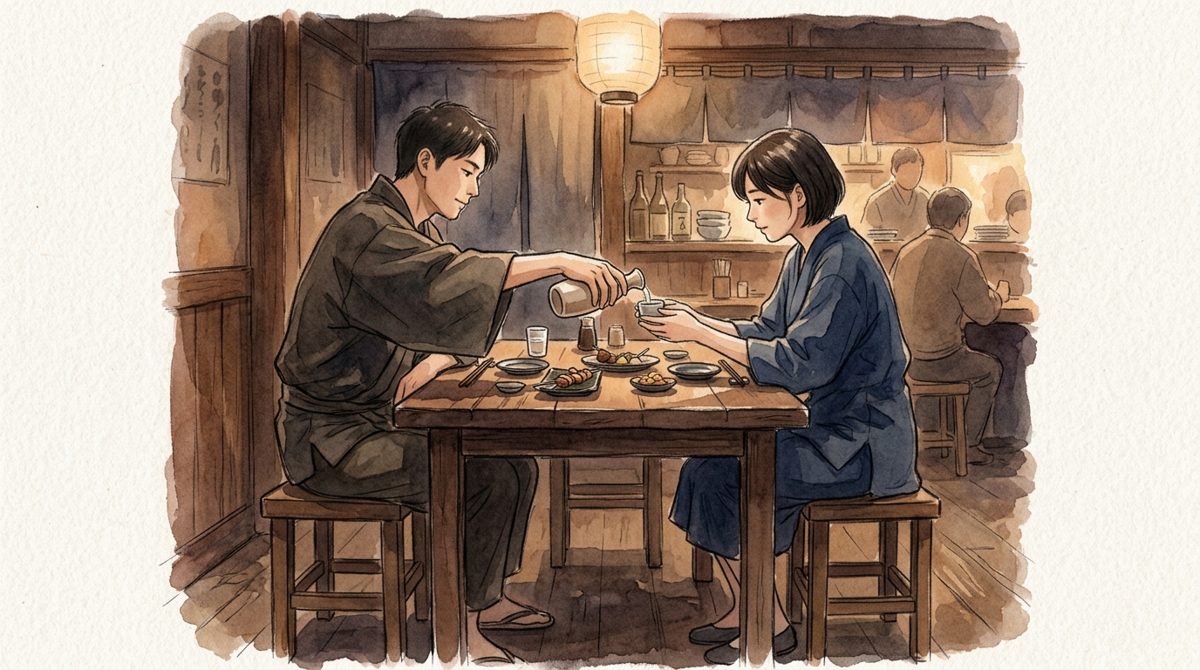
At a Japanese izakaya, you may notice that people rarely fill their own glass. Someone across the table reaches over with the bottle instead.
This is oshaku, pouring a drink for someone else. It is thought to bring the people at the table closer.
With sake, pouring for yourself can look as though the hospitality has fallen short. Pouring for the other person first is a way of placing yourself a step lower and showing respect. Younger people usually keep an eye on the glasses of those older than them.
There is also a simpler explanation. When everyone pours for each other, the drinks and the conversation keep moving on their own. In Japan, many of us glance at the other glasses on the table before our own.
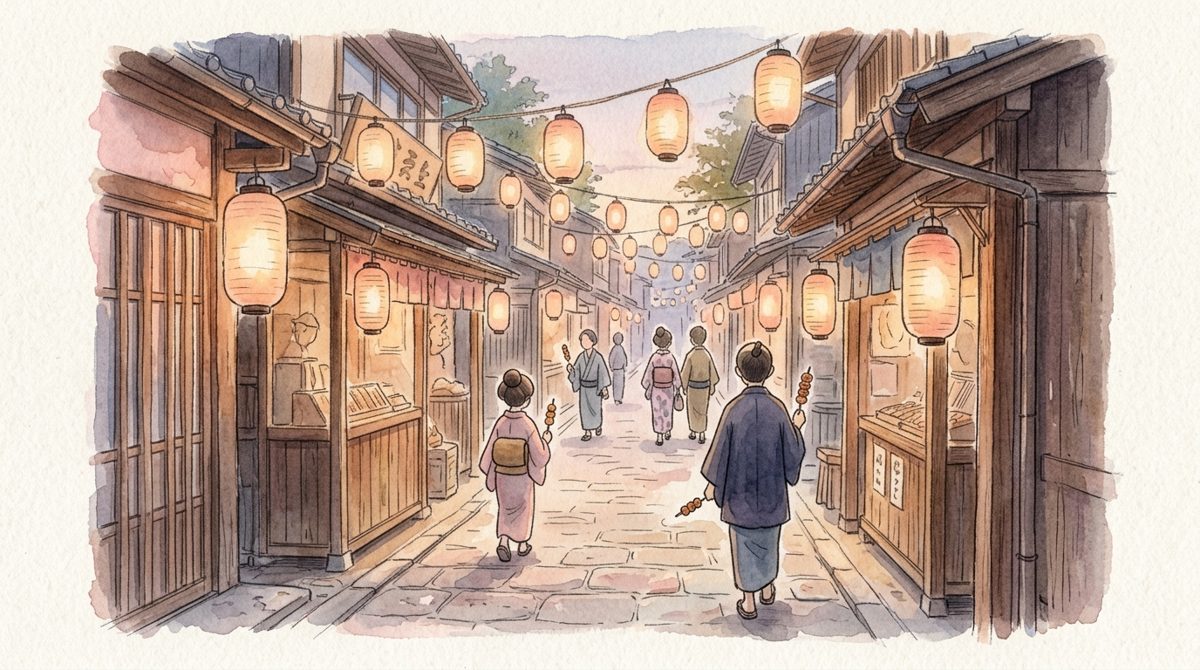
Visitors to Japan often notice that hardly anyone eats while walking. Then they find a sightseeing street where people are doing exactly that.
The word is tabearuki, roughly "eating while walking." In everyday life, most people don't do it, so it tends to look a little unusual.
The reasons people give are simple. Food is something you sit down for, or at least stop for. There are also few trash bins on the streets, so wrappers have nowhere to go. Some link it to wa, harmony with those around you, and the wish not to get in anyone's way.
It is not a strict rule. It sits closer to "that looks a bit odd." So I think a street full of people snacking on skewers may just be a place where that feeling loosens a little.
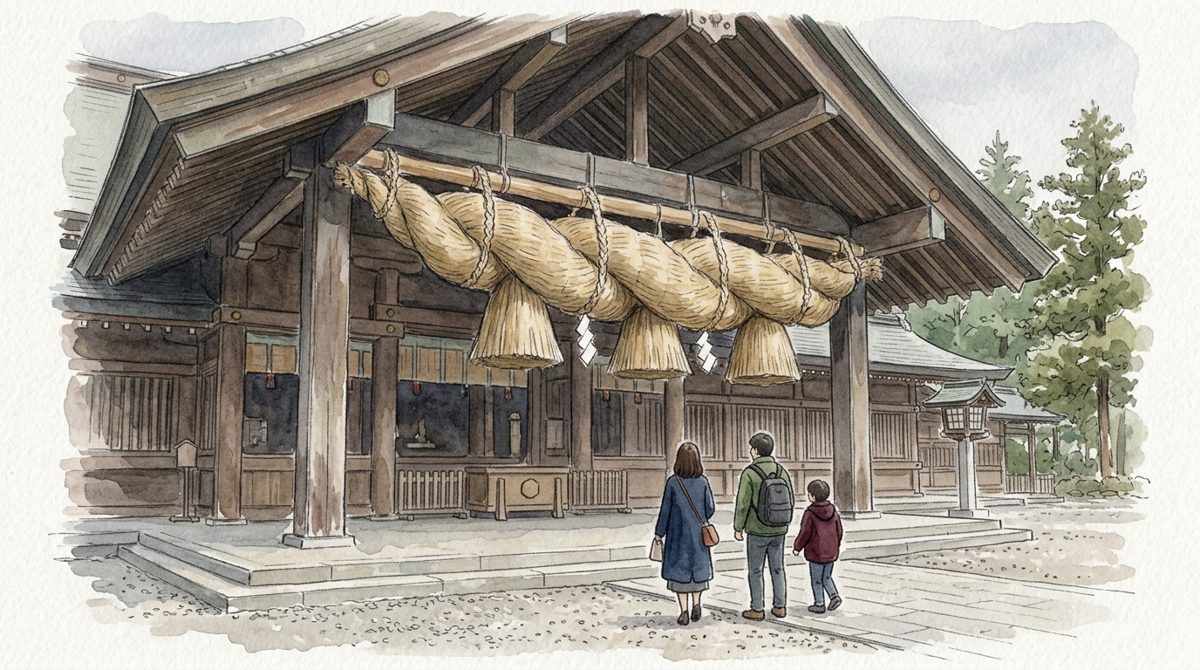
At most shrines in Japan, people clap twice. At Izumo Taisha, they clap four times.
The reason given is the deity enshrined there, Okuninushi no Okami, known as a god of bonds between people.
Then there is the rope. The ōshimenawa, roughly "great sacred rope," hangs at the Kaguraden hall. It is about 13.5 meters long, about 9 meters around, and weighs about 5 tons, said to be the largest in Japan. A shimenawa marks where a deity is present, a line between the sacred and the everyday. Large ones are typical of the Izumo region.
The shrine is recorded in Japan's oldest written records as early as the 700s. In Japan, many of us simply follow the way each shrine asks us to pray.
In the Heian court, dressing for late spring meant choosing colors in layers. One of those choices was ouchi-iro, the "chinaberry color."
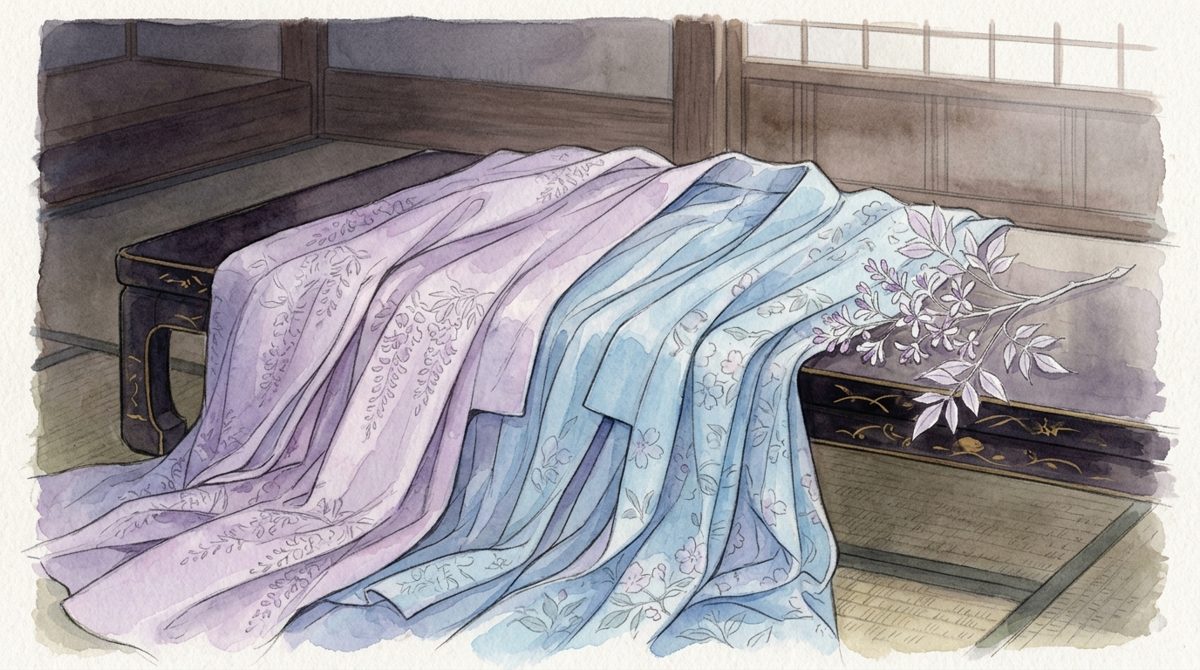
Ouchi is an old reading for the chinaberry tree, Melia azedarach. Ouchi-iro was one of the kasane no irome, the color pairings made by layering a robe's outer face over its lining. It is described as pale purple over blue, or purple over pale purple, and was worn around April and May.
These pairings were named after seasonal plants and trees. At court, knowing which colors went together was a mark of education.
When I see the season and a color tied together in Japan today, I think of how far back that habit seems to go.
Japan has a traditional color name that simply means egg.
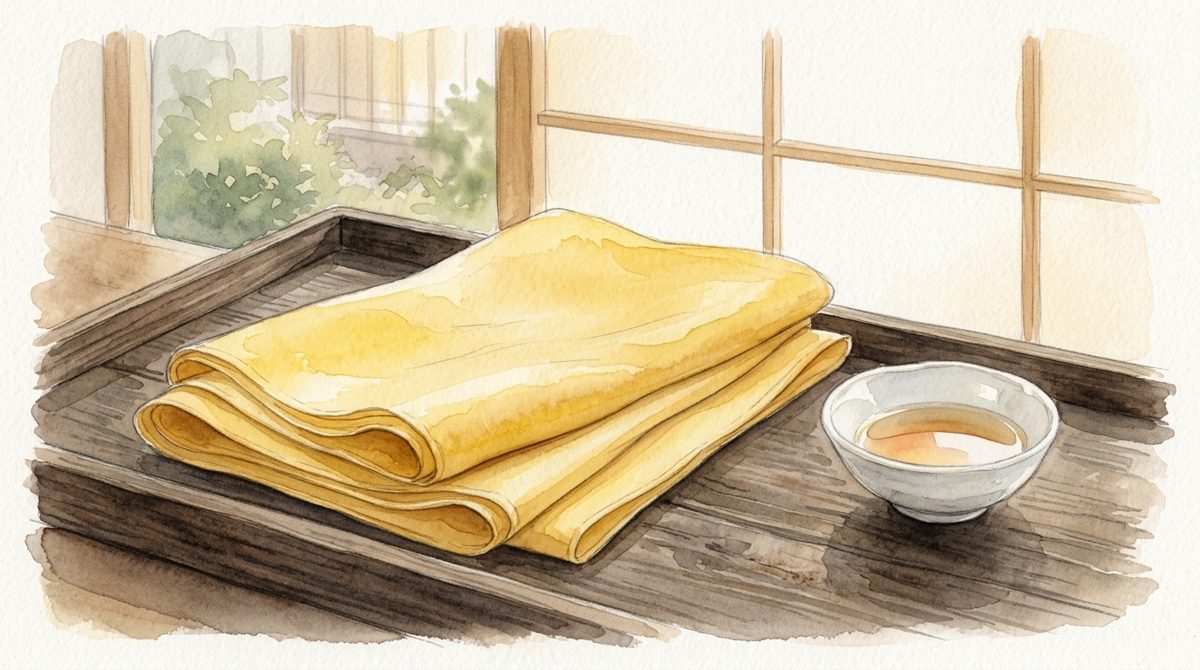
It is tamago-iro, roughly "egg color," a warm yellow likened to the yolk. The name is said to date from the early Edo period. That was also when the written form 玉子 for egg settled in and spread, around the time eggs were gradually becoming something people ate.
Not everyone agrees on which egg it means. One view says the yolk itself. Another says yolk and white mixed together, and another says the yolk of a boiled egg.
In Japan, many of us say tamago-iro without ever thinking about when it began. I like that a color name quietly kept a trace of what people had started to put on the table.
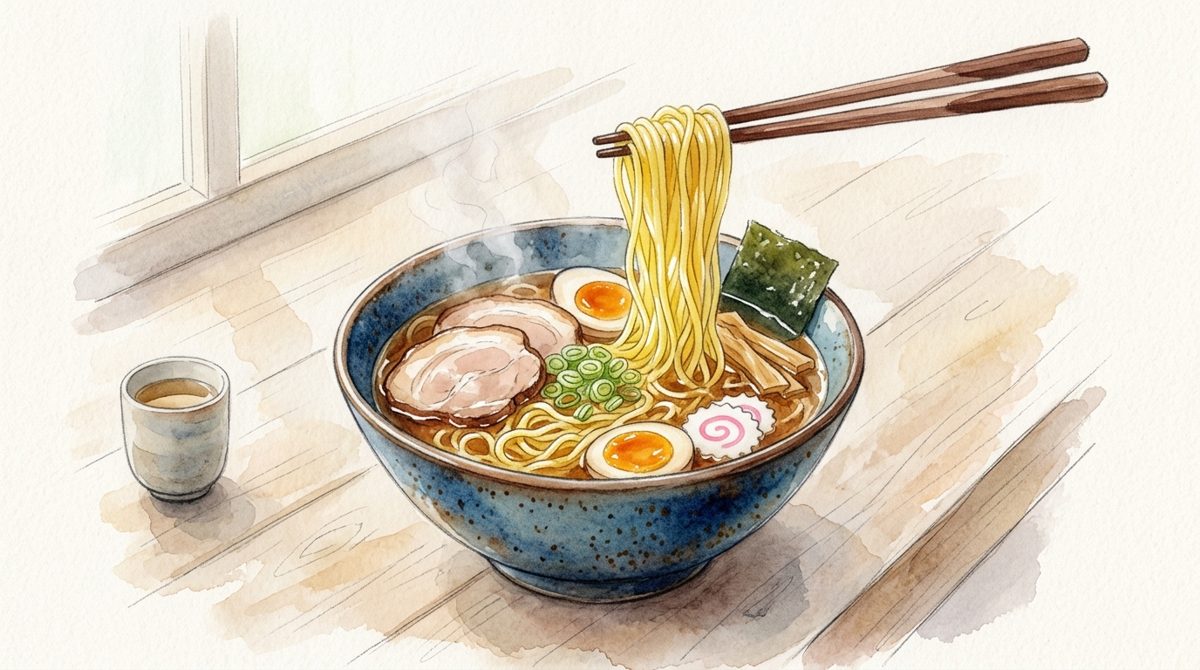
You lift your chopsticks, and there it is on top of the ramen: a small white disc with a pink spiral. Many visitors ask what it is.
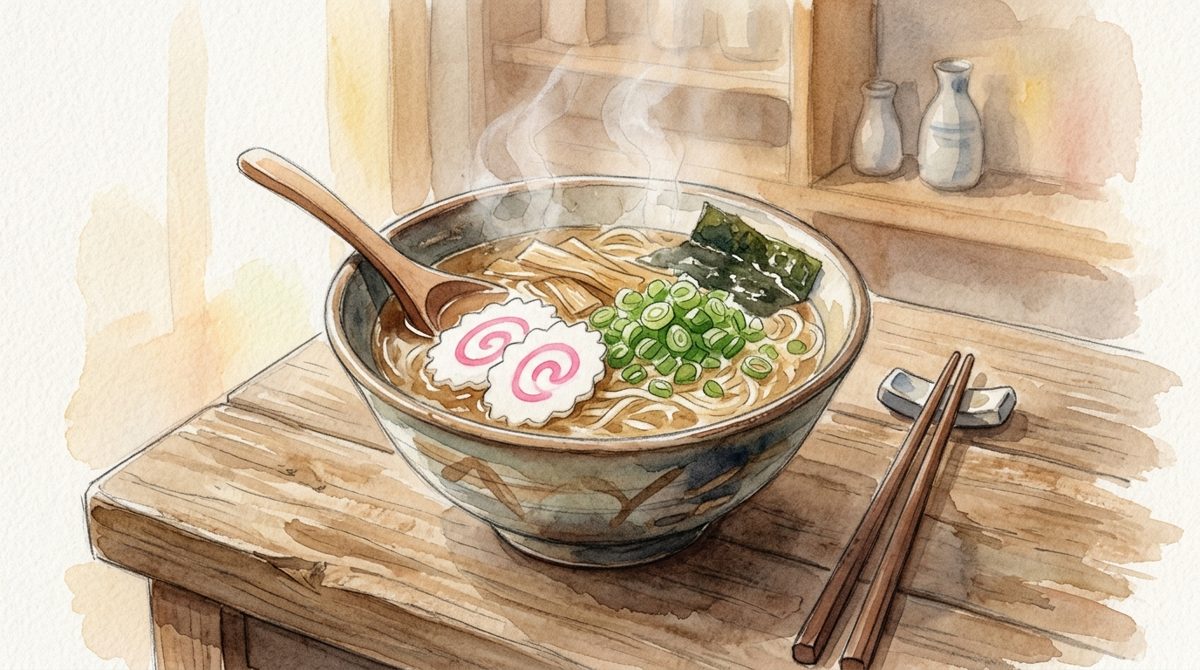
It is narutomaki, roughly "Naruto roll." It is a kind of kamaboko, or fish cake. White fish is ground into a paste and seasoned with salt, sugar, sake, mirin and egg white. Then it is shaped into a log, given its color with red food coloring, and steamed or boiled.
The name is said to come from the whirlpools of the Naruto Strait, between Awaji Island and Shikoku. When you slice it, the swirl looks like one of them.
In Japan, many of us hardly notice it anymore. It turns up in udon and soba too, a small spiral floating quietly in the broth.
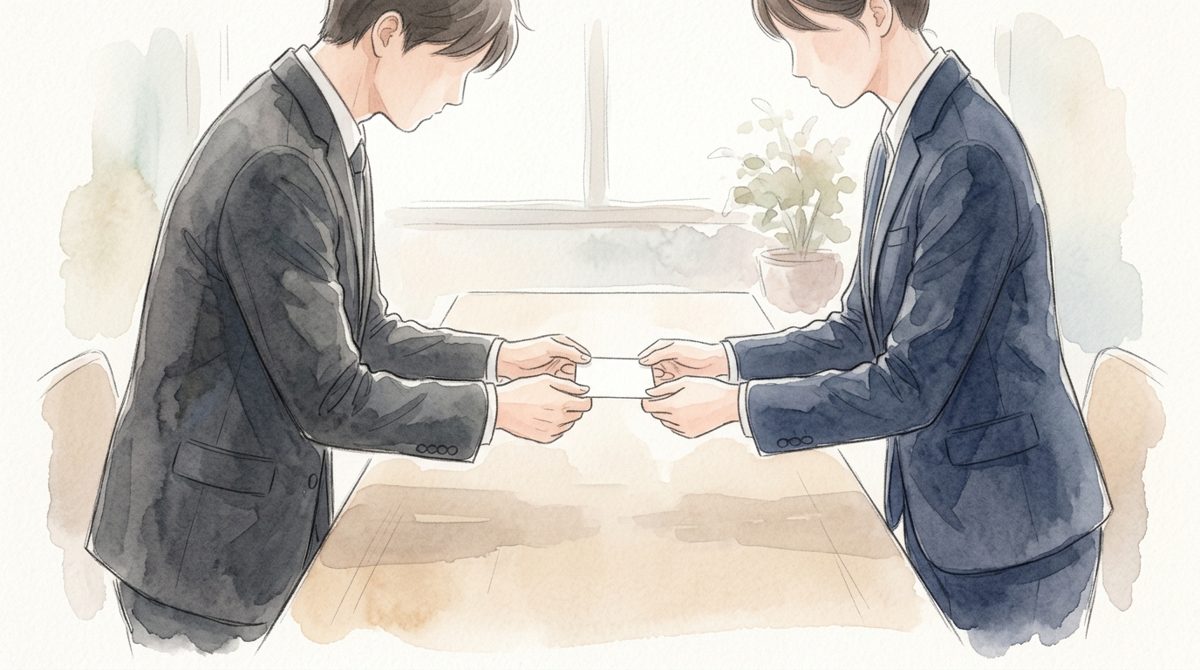
In a Japanese meeting room, two people bow slightly and hand each other small cards, both using two hands. It can look almost like a ceremony.
This is meishi koukan, the exchange of business cards.
The card introduces both your company and yourself, so it is handled with care. You hold it with both hands, turned so the other person can read it. They take it with both hands too.
Then you don't put it away right away. You look at the name and the title. That moment of reading is how you show respect. Slipping it straight into a pocket or bag is easily seen as rude.
I worked in Japanese companies for 37 years. In that world, those few seconds of reading are part of the greeting itself.
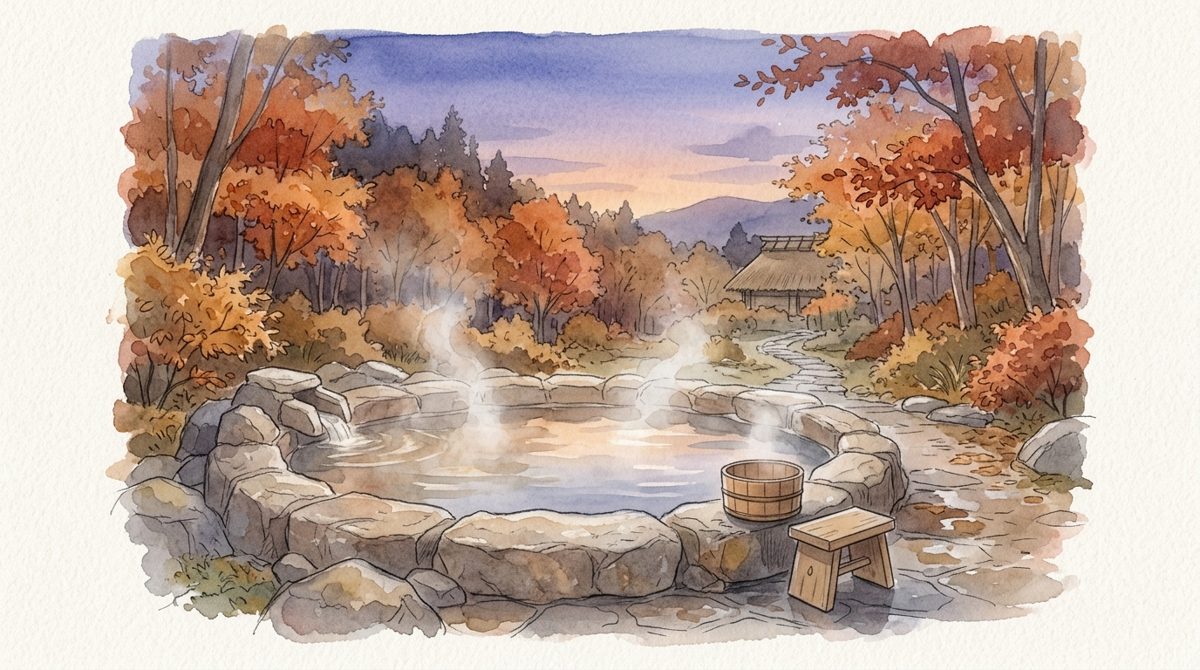
At an onsen, first-time visitors are often surprised that everyone washes before going near the bath.
Before stepping in, you do kakeyu, pouring hot water over yourself.
The reason is plain: the water is shared. So you wash first and come in clean. If sweat, dirt or soap is left on you, you may be turned away. Some also say washing first helps the minerals reach your skin.
Tattoos are another question. They have long been linked with organized crime groups, so many baths refuse them. Some places that welcome travelers accept them. It helps to ask first, or cover them with a patch.
In Japan, many of us learn this order as small children, long before we know why.
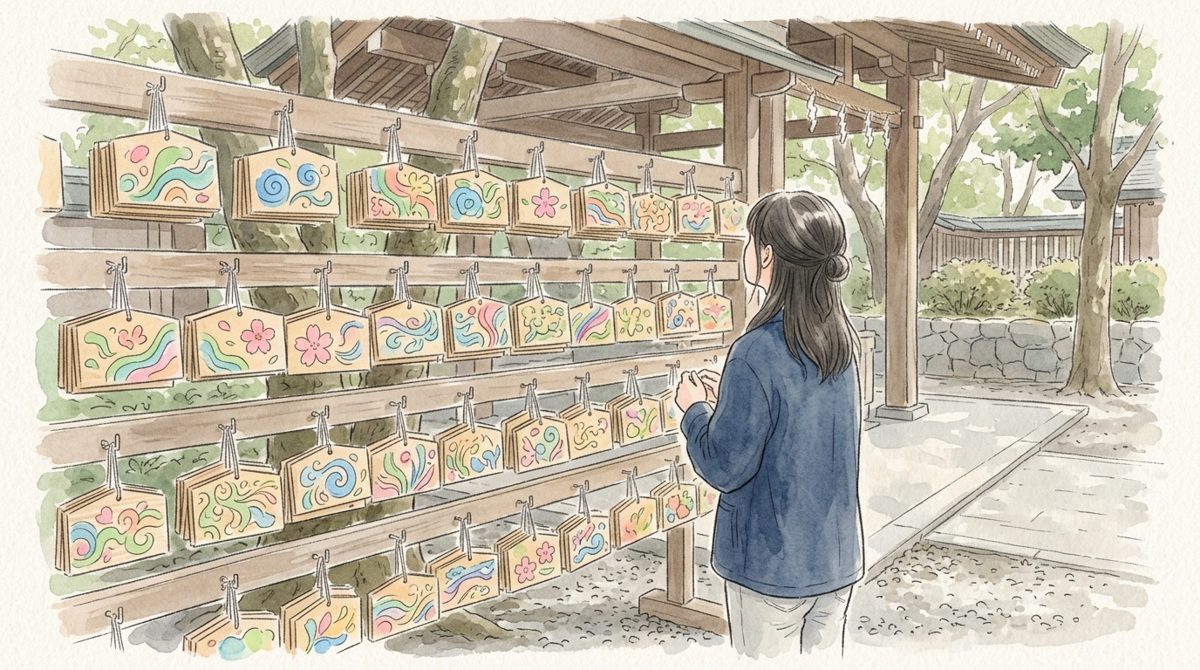
At a shrine in Saitama, the prayer plaques are covered with hand-drawn anime art.
This is seichi junrei, "pilgrimage to sacred places." Once it meant holy sites. Now it also means visiting the real towns, stations and shrines drawn in anime.
The shrine in Lucky Star was modeled on Washinomiya Shrine. New Year visitors are said to have grown from about 130,000 in 2007 to about 450,000 in 2010.
Fans leave drawings and messages on ema, the prayer plaques. Locals ask them not to enter private land, take photos from the road, or park by the station.
In 2016, the year of Your Name, it made the top ten of a national buzzword award. In Japan, many of us watched an old word find a second life.
A deep blue-black, close to the color of ink, and yet its name ends in "tea."
The color is aisumicha. Ai is indigo, sumi is ink, and cha, "tea," was also a word for brownish dyed colors.
Despite the "cha," the color sits near gray-black. In the Edo period, when bright colors were restricted for townspeople, browns and grays were split so finely that people spoke of "48 teas, 100 mice."
In Japan, many of us pass over dark colors as plain. This one holds three colors in a single name.
A bowl of Hakata ramen arrives, and the soup looks almost like milk. There is no milk in it.
The word is tonkotsu, which simply means "pork bone."
For a clear stock, you keep the pot at a quiet simmer. Tonkotsu does the opposite. Pork bones, such as thigh bones and feet, are kept at a hard boil, for what is said to be ten-plus hours.
That rough boil pulls marrow, collagen and fat out of the bones and mixes them into the water. That is to say, the white is an emulsion, made by heat and time.
The style is said to have started around Hakata in Fukuoka and the wider Kyushu area. In Japan, many of us read that cloudy color as a sign that someone kept the fire going all day.
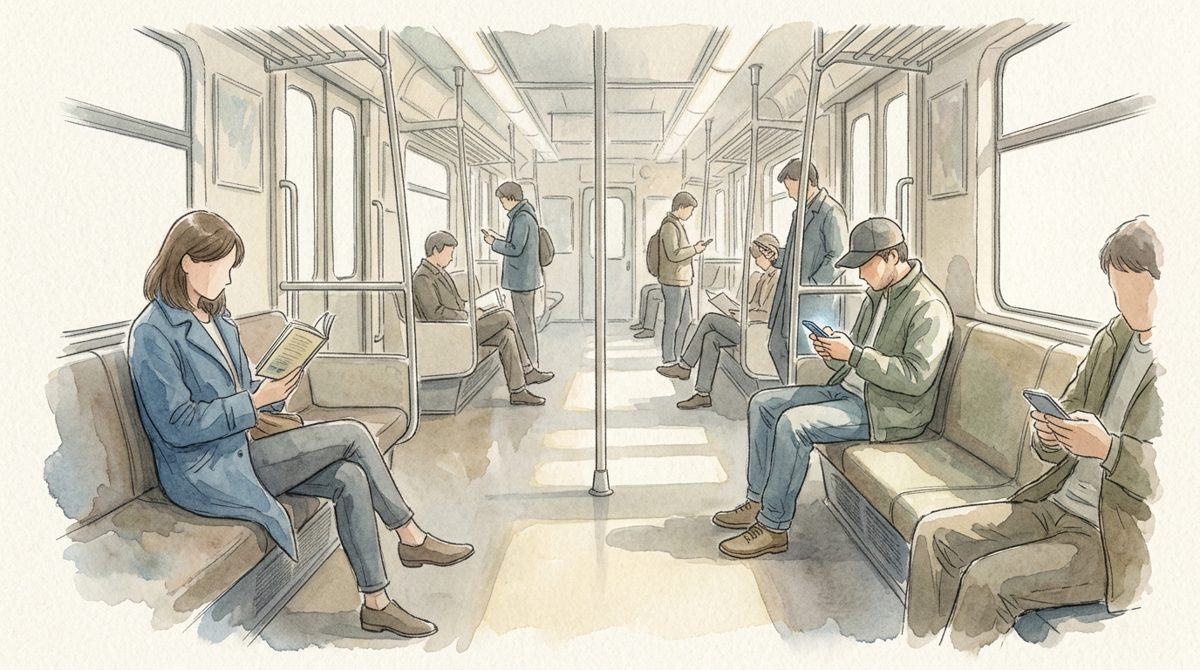
Many visitors notice it on their first ride. A crowded train in Japan can be surprisingly quiet.
People read, look at their phones, or rest. Their phones are on manā mōdo (マナーモード), "manner mode," the setting that silences the ringtone or switches it to vibrate.
Taking calls on board is seen as poor manners. When a phone does buzz, many people answer only to say, "I'll call you back," and hang up. Near the priority seats, people give up their seats to older people, people with disabilities, pregnant women, and parents with small children.
Underneath is one simple idea. Try not to be a bother to others.
In Japan, many of us switch to manner mode as we step on, almost without noticing.
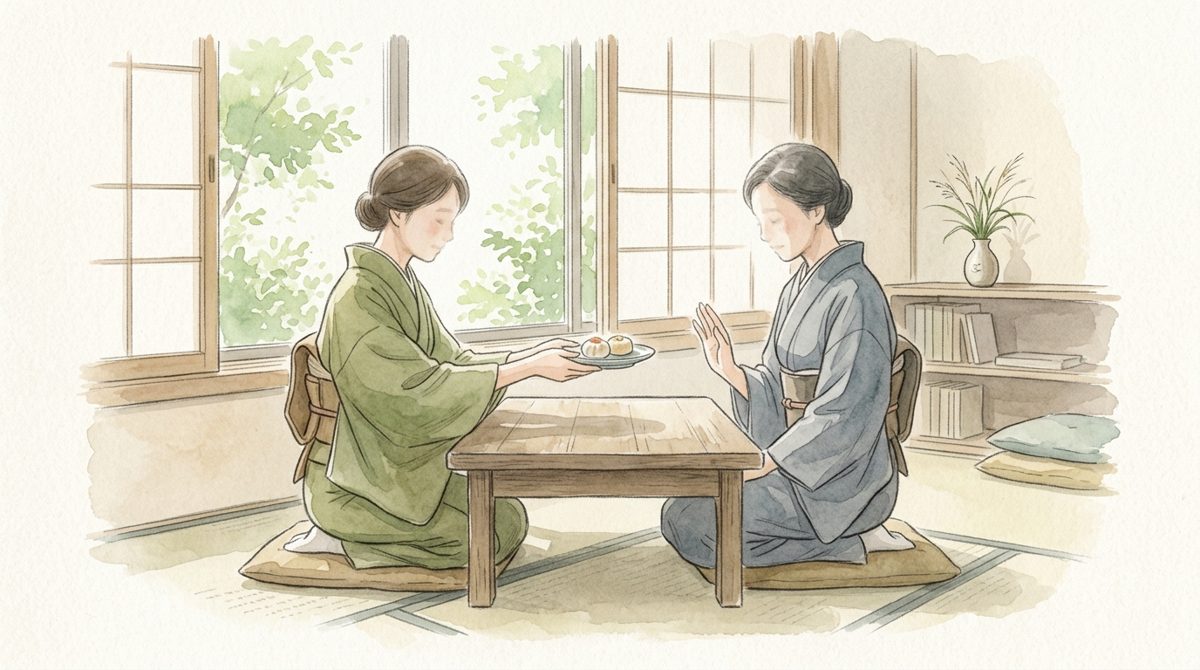
You offer a Japanese friend a cookie. They smile and say, "Oh, no, I'm fine." You offer again, and this time they take it.
That first no often comes from enryo (遠慮), roughly "holding back out of consideration."
Enryo means keeping your own wishes in check out of care for others. When you are a guest, declining once can be the polite move. The host says, "Please don't hold back," and the guest accepts. Decline, offer, accept.
The first refusal is usually a courtesy rather than a real no. Someone who never holds back can even seem a little pushy.
In Japan, many of us offer twice without thinking. It leaves the other person room to say yes.
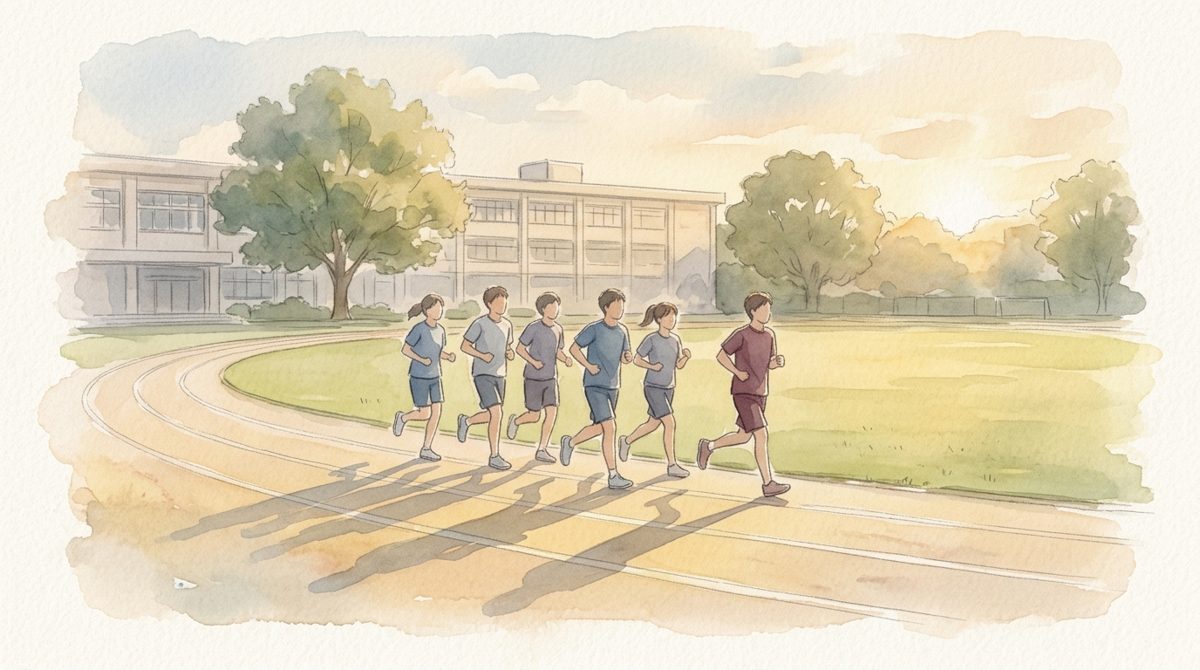
In almost every school anime, someone is running late for club practice. Is school in Japan really like that?
In many ways, yes. The word is bukatsu (部活), short for "club activities."
Clubs are a large part of junior high and high school life. Many students join one and stay for years. A club is seen as a place to learn a skill, and also teamwork, responsibility and manners that help later in life.
In Japan, many of us can still name our club long after our grades are forgotten.
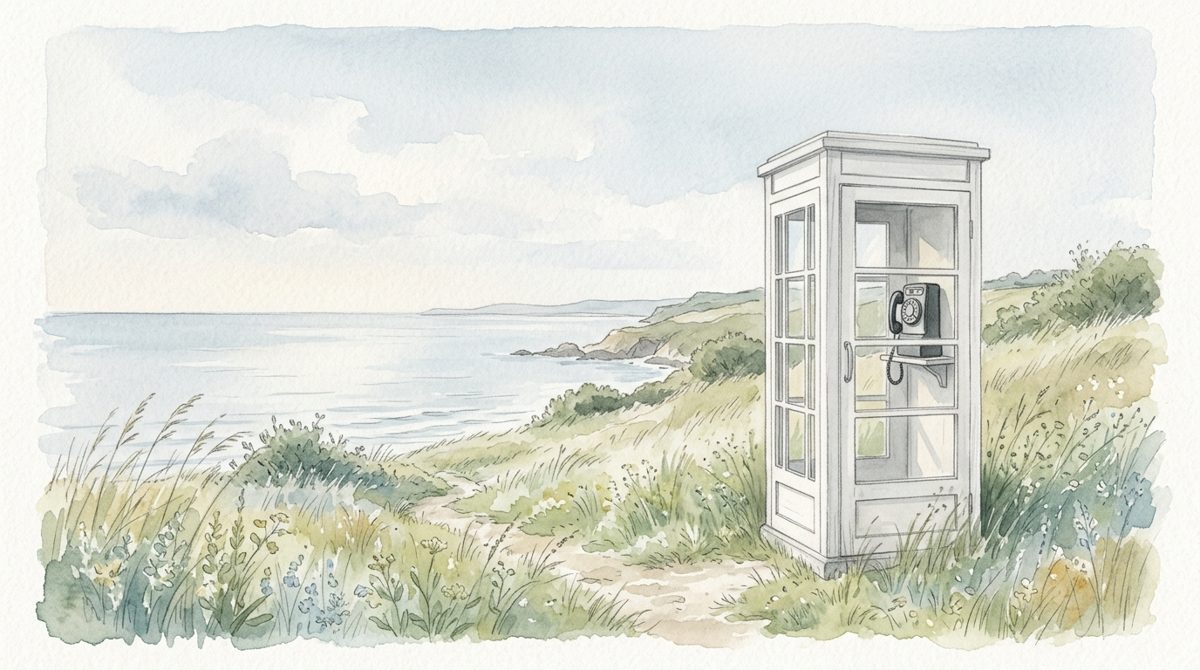
On a hill in Otsuchi, Iwate, stands a white phone booth with an old black telephone inside. The line is connected to nothing.
It is called kaze no denwa (風の電話), "the wind phone." People come to speak to someone who has died and send the words off on the wind.
A gardener set it up in his own garden, wishing he could talk with a cousin he had lost. After the 2011 Great East Japan Earthquake, he opened it to grieving families. More than 30,000 people are said to have come, though sources differ. A local group now looks after it with the garden. Visitors are asked to come quietly, as if putting their hands together.
In Japan, many of us still speak to the people we have lost.
On one mountain path in central Japan, most hikers have come from abroad.
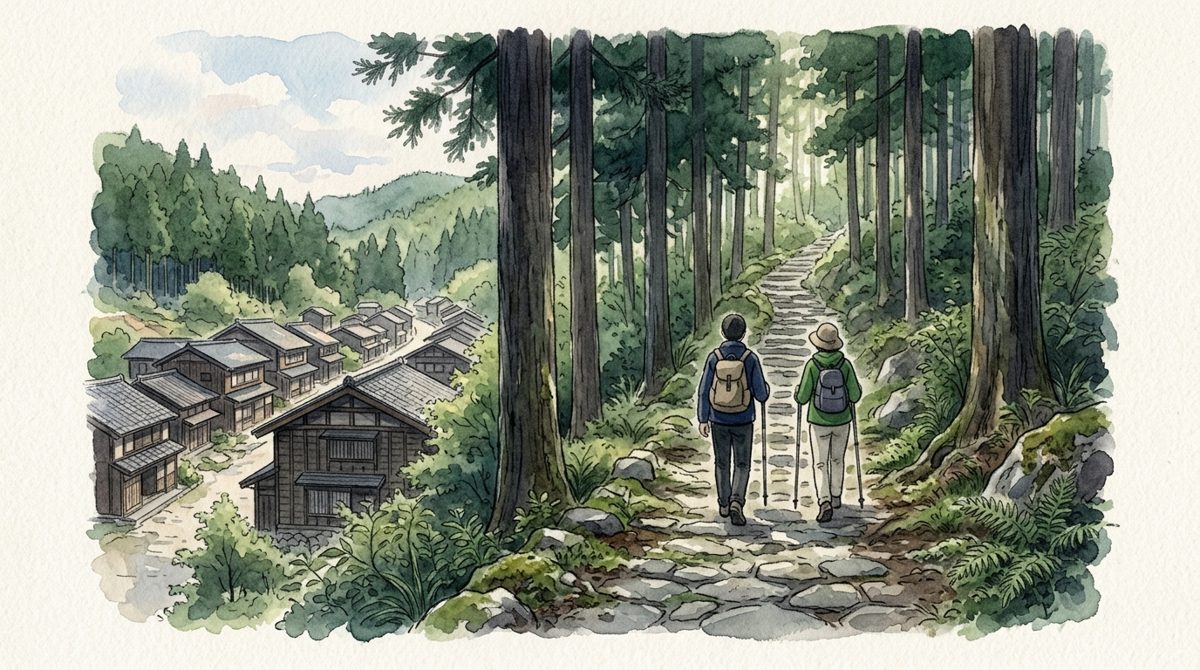
The path joins two shukuba (宿場), "post towns," on the Nakasendo, a road from the Edo period. Magome was the 43rd of its 69 stations. Tsumago, over the pass, was the 42nd.
The walk is about 9 km, around three hours. Japanese travel media say about 80 percent of walkers are foreign visitors, some of whom call it the Samurai Road. From April to December 2019, a local group counted over 53,000 hikers, the first time it passed 50,000.
Along the way, the stone streets give way to forest and two waterfalls, Odaki and Medaki.
In Japan, many of us think of the Edo period as long ago. Here it is a three-hour walk.
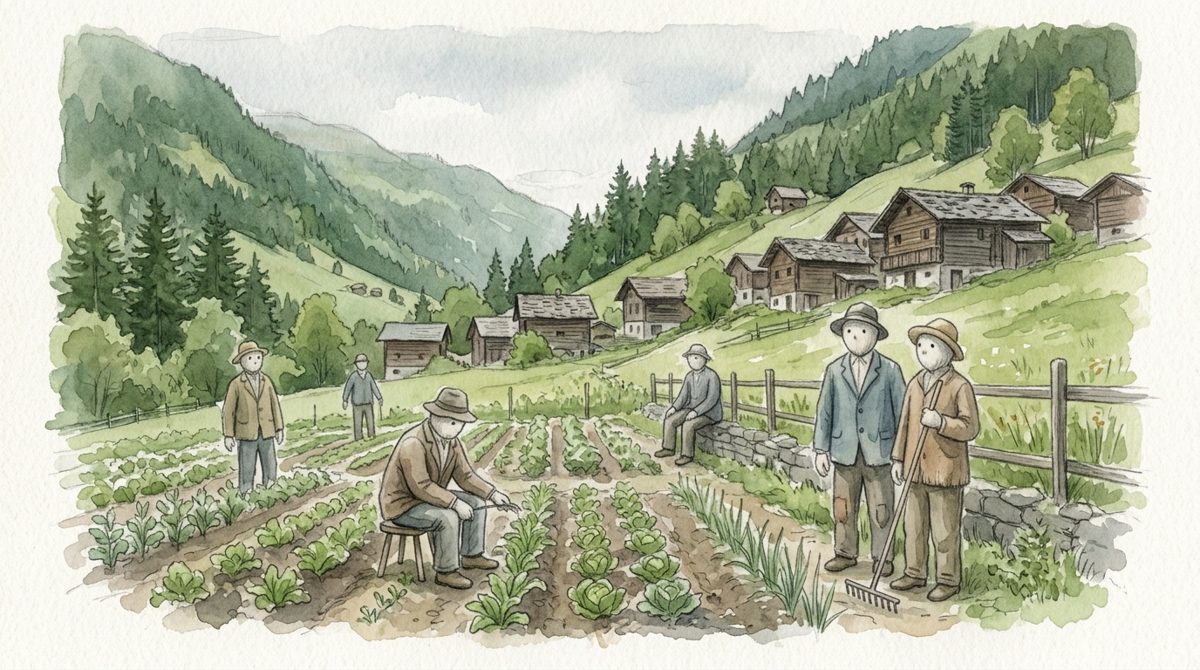
In one mountain village in Tokushima, the figures in the fields far outnumber the people.
They are kakashi (案山子), "scarecrows." The village is Nagoro, in the Iya Valley.
It began in 2002, when a woman who had moved back from Osaka made one in her father's likeness to keep birds off the seeds. More followed, many shaped like residents who had died or moved away. There are said to be hundreds now.
The village once had over 300 people. Now it has a few dozen. It is hard to reach, yet travelers come every year.
In Japan, many of us know places like this, where the houses remain and the people grow fewer.
At a crossing in Japan, the green light is called the blue light. The reason is very old.
The word is midori (緑), "green." One common explanation links it to mizumizushii, "fresh and full of life," and says it first meant the color of new leaves.
For a long time, green was treated as a kind of ao, "blue." In old poems, the green of trees was called ao. That overlap is still here. A green traffic light is ao-shingo, a "blue signal."
Midori is also a common given name. When many of us hear it, we think of something young and full of life.
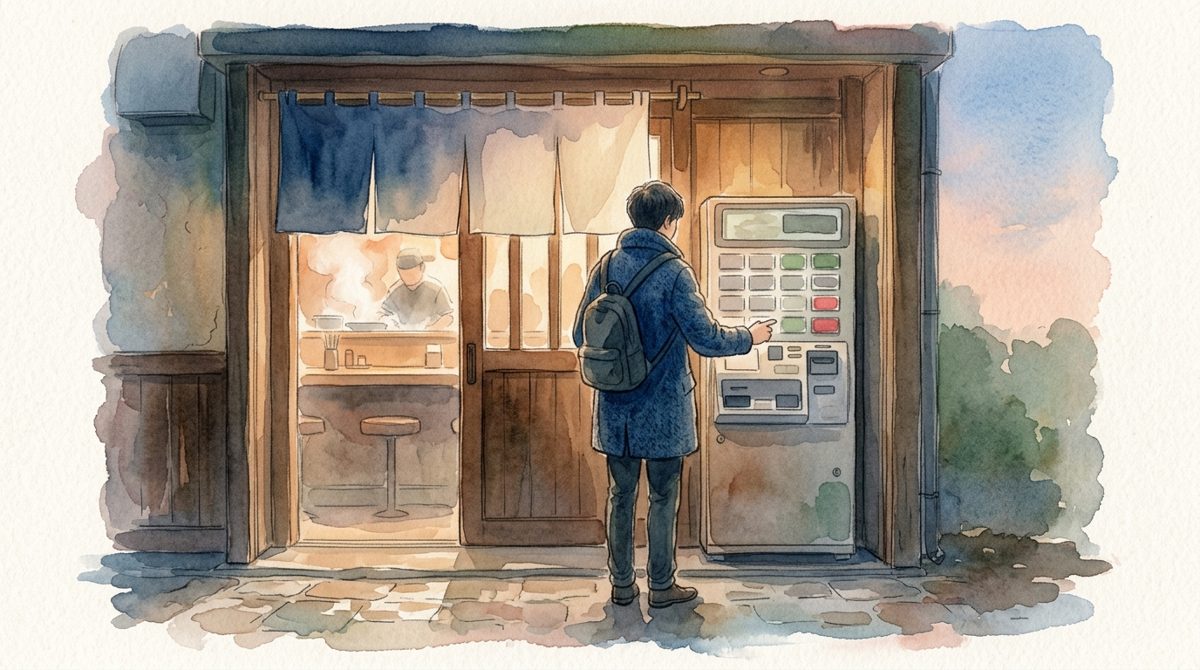
You walk into a small ramen shop, and before anyone greets you, there is a machine by the door waiting for your money.
This is shokken (食券), a "meal ticket." You put in money, press a button, and a ticket comes out with your order on it.
Hand it to the staff or leave it on the counter, and you have ordered. Some shops tear it in half. You never have to say the dish out loud. If the menu is hard to read, the top-left button is often the most popular bowl. Some machines take only cash, others take transit IC cards.
In Japan, many of us find it a quiet kind of ease. The cook keeps cooking, and nobody has to explain themselves.
Watch anime for a while and you hear one name said with -san, -kun or -chan.
These are keishou, honorifics added after a name.
-san is the most common. It is close to Mr. or Ms., but fits anyone, almost anywhere. -kun shows closeness, used for male friends the same age or younger, and at work sometimes for younger or junior women. -chan also shows closeness, often for female friends the same age or younger, children and pets.
Using no honorific at all is kept for the closest people, a partner or a very close friend. So when a character drops the -kun, the relationship has changed.
In Japan, many of us notice the day someone stops adding -san to our name.
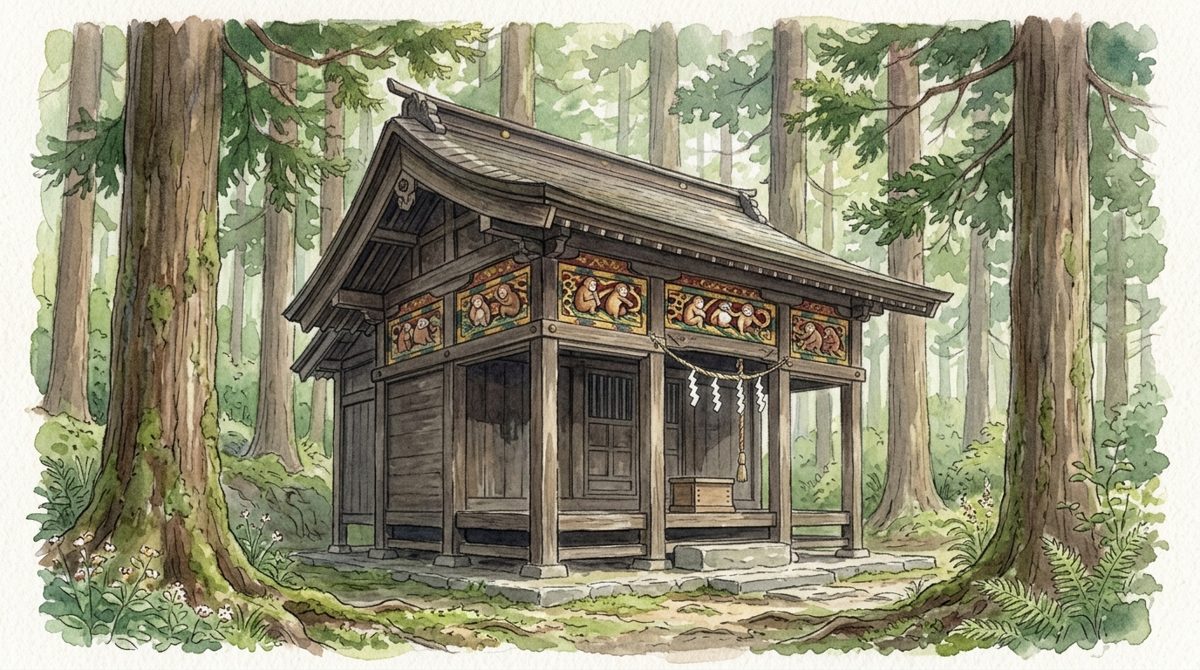
At Nikko Toshogu, the famous three monkeys who see, hear and speak no evil are carved on a stable.
They are sanzaru, "the three monkeys."
The building is the sacred stable for the shrine's horse. Its beams carry 16 monkeys in all, telling the story of a life, and the three are only one scene. Monkeys were long thought to protect horses. Monkey performers were brought to stables for prayers, and it is said horses settle down with a monkey nearby.
The three stand for early childhood. They carry a wish to raise a child without seeing, hearing or saying anything bad.
In Japan, many of us know these three well, yet few of us have looked for the other thirteen.
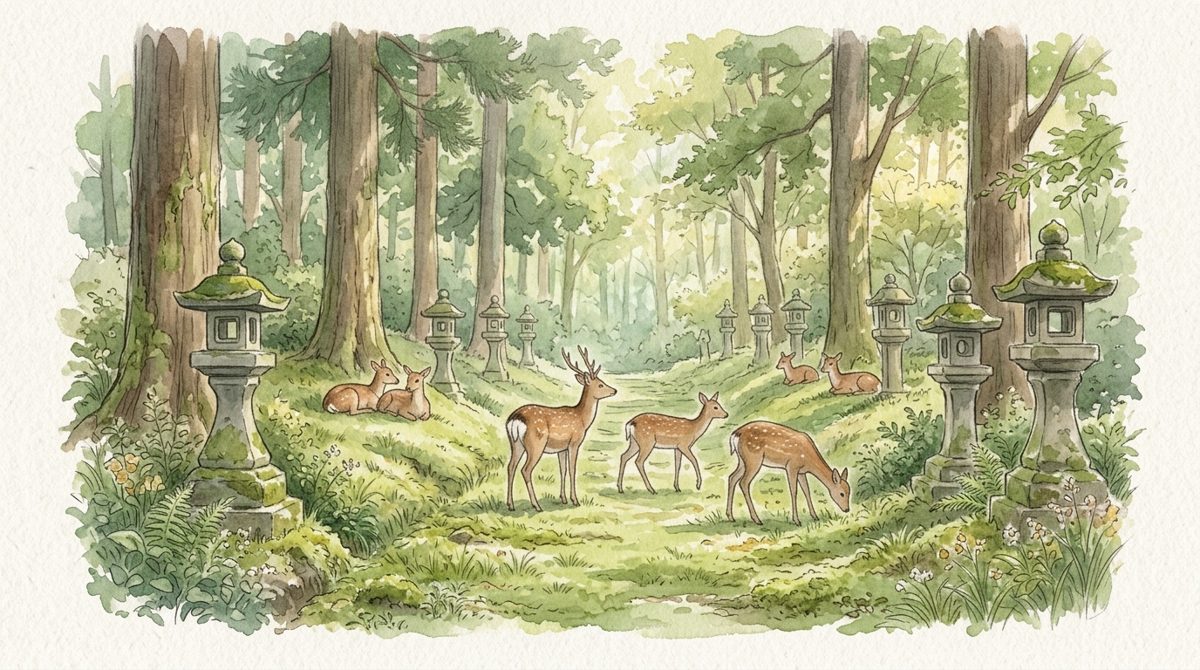
In Nara, deer walk calmly through the park and around an old shrine, quite used to people.
They are called shinroku, roughly "sacred deer."
The main deity of Kasuga Taisha, founded in 768, is said to have come to Nara from Kashima riding a white deer. Deer have long been honored as messengers of the god and protected around the shrine.
A genetic study found Nara Park's deer carry a type seen nowhere else on the Kii Peninsula. Researchers estimate they split off over 1,000 years ago and link this to that long protection.
I find it remarkable that a belief kept that long can end up written in the animals themselves.
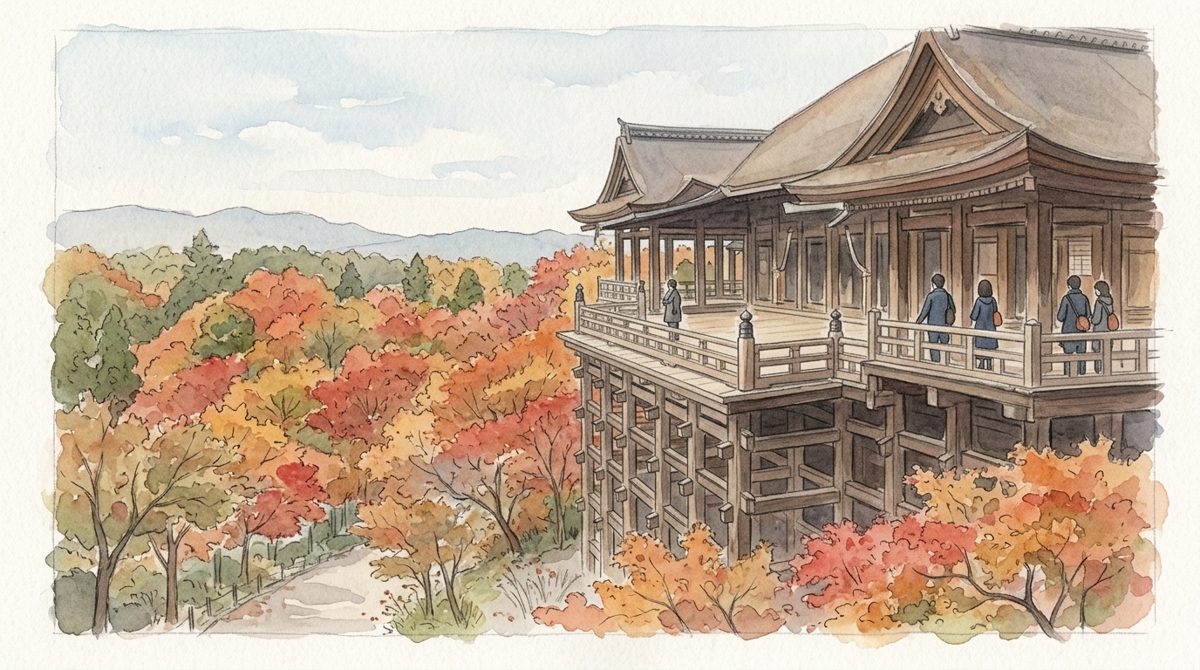
There is a Japanese saying about jumping off a temple stage. People really did jump.
Kiyomizu no butai means "the stage of Kiyomizu," at Kiyomizu-dera in Kyoto.
The saying comes from the Edo period, when some people jumped from the stage in front of the main hall, praying that a wish would come true. They carried serious wishes, such as recovery from illness or a change of work. One often-cited record counts 234 jumps, with a survival rate of 85 percent.
Because it was so dangerous, Kyoto Prefecture banned jumping in 1872, and the custom faded.
In Japan, many of us still say the phrase before a big decision, usually with a small smile.
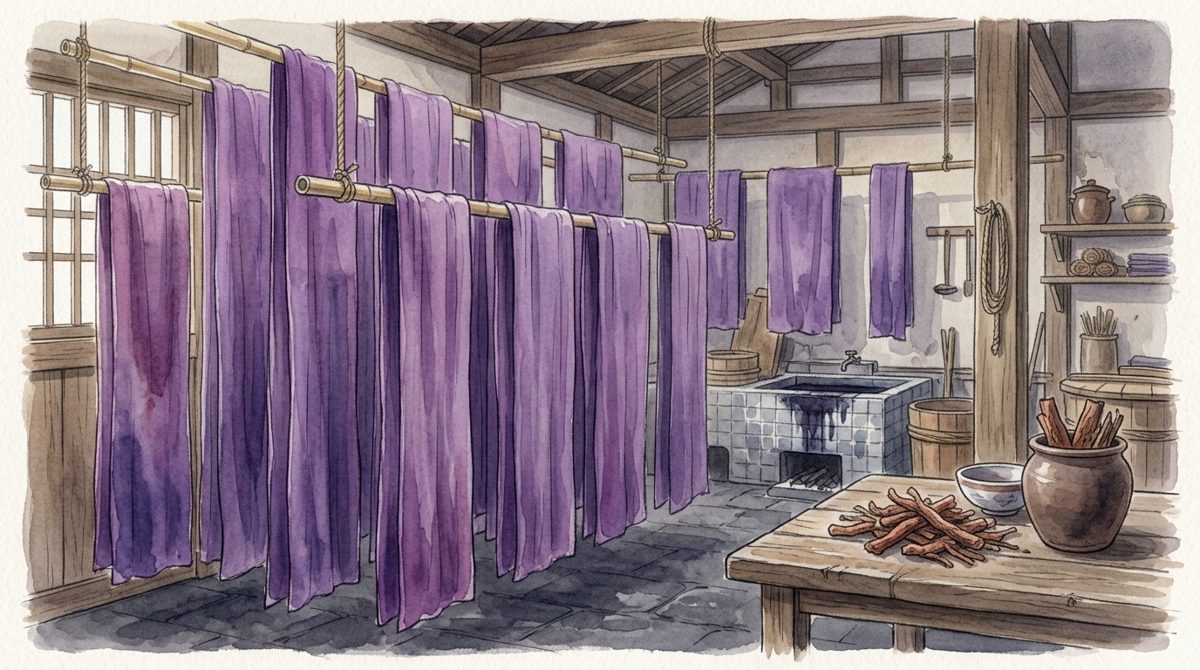
Could ordinary people in Japan wear the deepest purple? For a long time, it was kept for those at the very top.
Murasaki means purple. Koki-murasaki was the deep purple of the highest rank.
In the early 600s, twelve court ranks were set up, shown by the color of officials' caps, and deep purple sat at the top. The dye came from the root of a plant also called murasaki, and drawing out the color took great effort. Second came a lighter purple, then blue, red, yellow, white and black, each in dark and light.
Today, purple is still the color used to celebrate turning 70 or 77.
In Japan, many of us feel a little formal around this color.
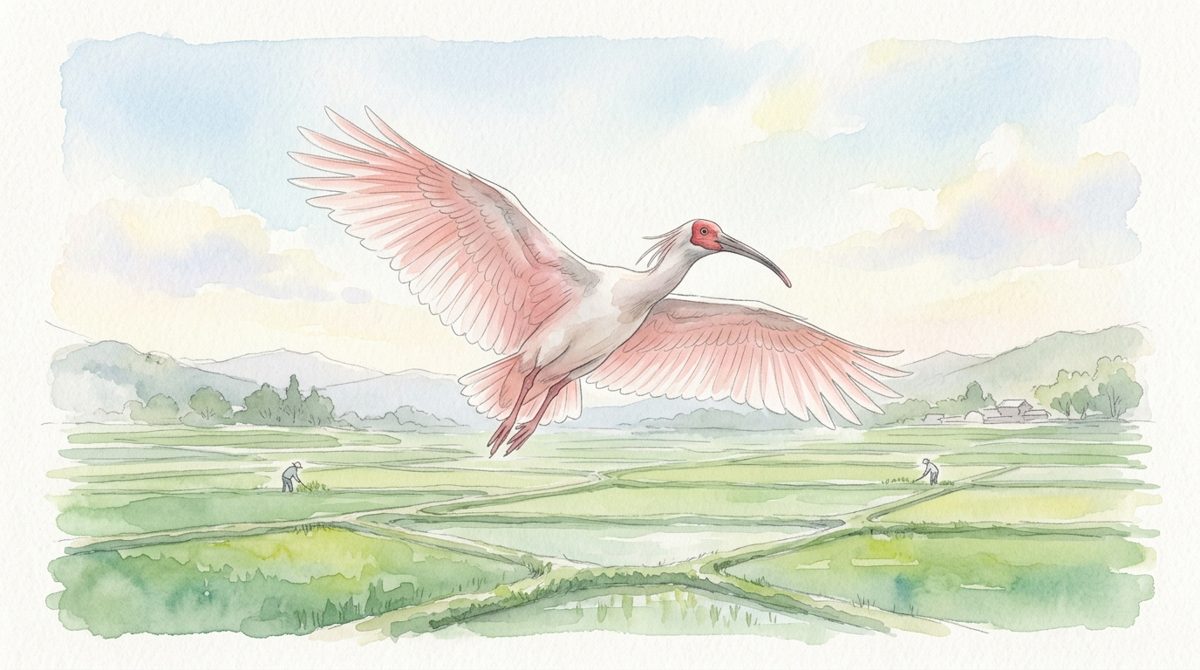
Toki-iro means "the color of the toki," the crested ibis.
At a glance, the toki looks almost white. It is a large bird, about 70 to 80 cm long. When it opens its wings, a pale red-pink shows on the inner side and the flight feathers. That hidden color gave the name. Other color names grew from it, such as toki-asagi.
The toki was once found across Japan. Overhunting pushed it close to extinction, and today it is protected.
I suspect many of us in Japan know the name of the color better than we know the bird itself.
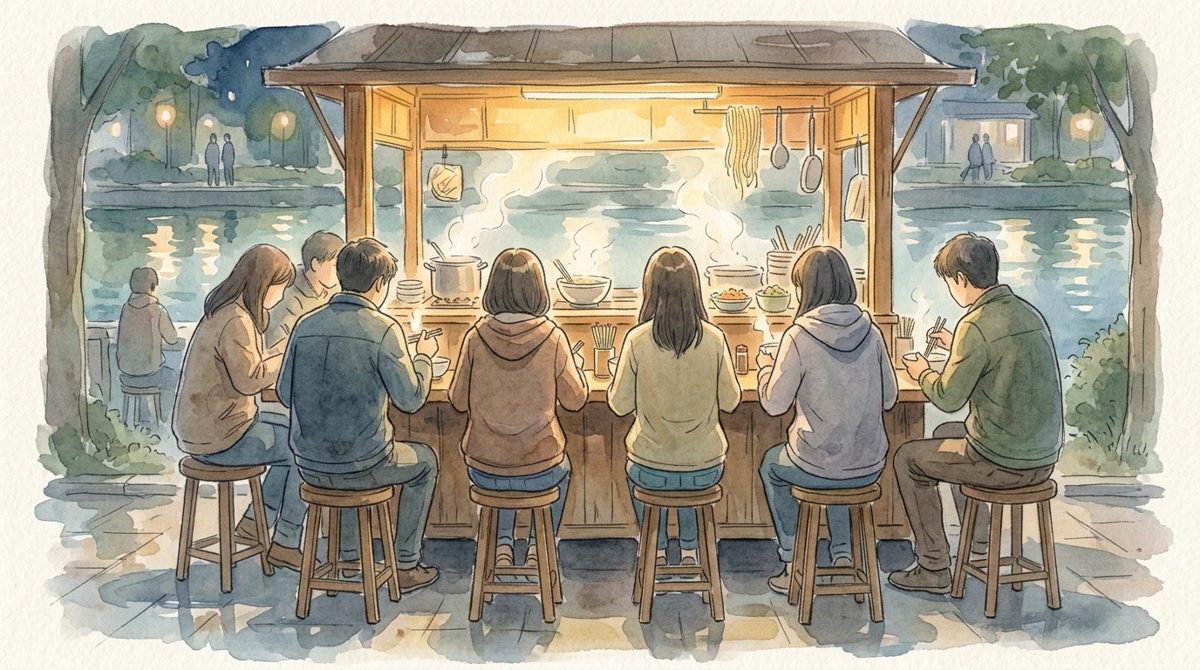
Late at night in Fukuoka, strangers sit side by side at a street stall, eating ramen in the open air.
The word is yatai, roughly "a stand with a roof."
They are said to have started on street corners in 1945, right after the war, to feed people who had very little. Around 1965 there were more than 400. Hygiene and traffic laws closed many of them, and in 2013 the city set rules to keep the rest. As of July 2020, 102 were open in Nakasu, Tenjin and Nagahama.
Nagahama is said to be the birthplace of a ramen with thin noodles in pork-bone broth, and stalls serve oden and yakitori too.
In Japan, many of us remember a yatai night less for the bowl than for the person on the next stool.
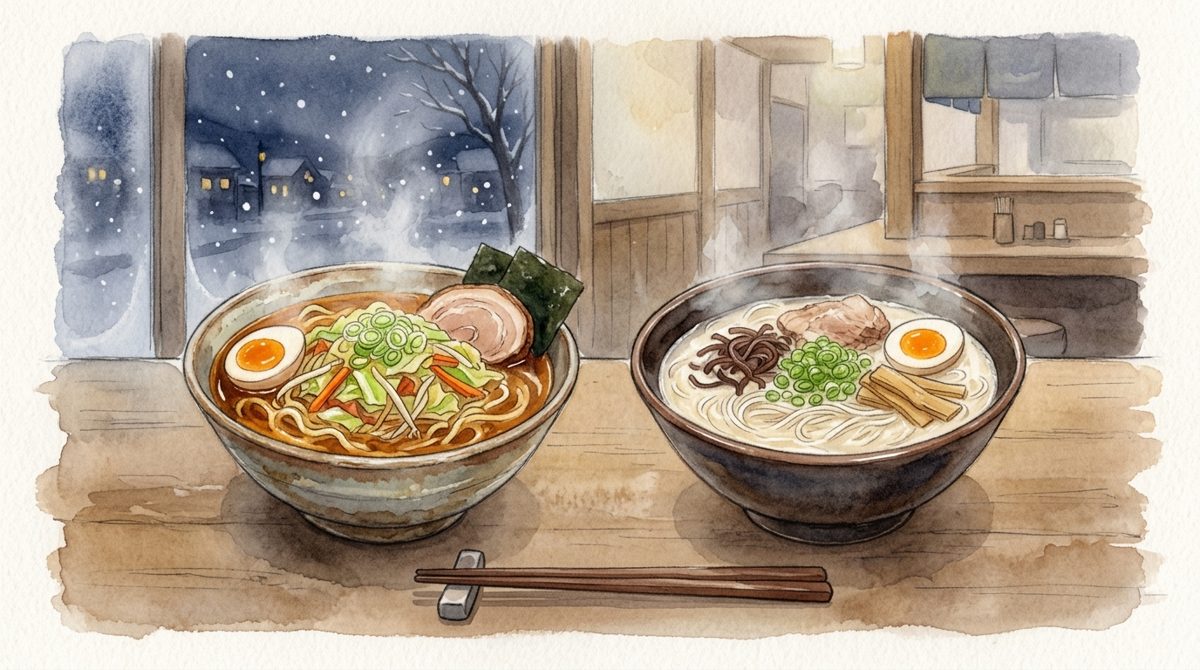
Ramen in Sapporo and ramen in Hakata feel like two different foods.
Sapporo is known for miso ramen, ramen in a soup seasoned with fermented soybean paste. It is said to have been born there after World War II.
Winters are cold, and the usual story is that people wanted a soup richer than soy sauce or salt, one that stays hot. Vegetables are stir-fried in lard and garlic, then simmered with pork bone broth and miso. The noodles are thick and wavy.
Hakata goes the other way. Pork bones boil for hours into a dense broth, with thin, straight noodles that cook fast and are eaten before they go soft.
Many of us in Japan name a ramen by its town. The name alone tells you what to expect.
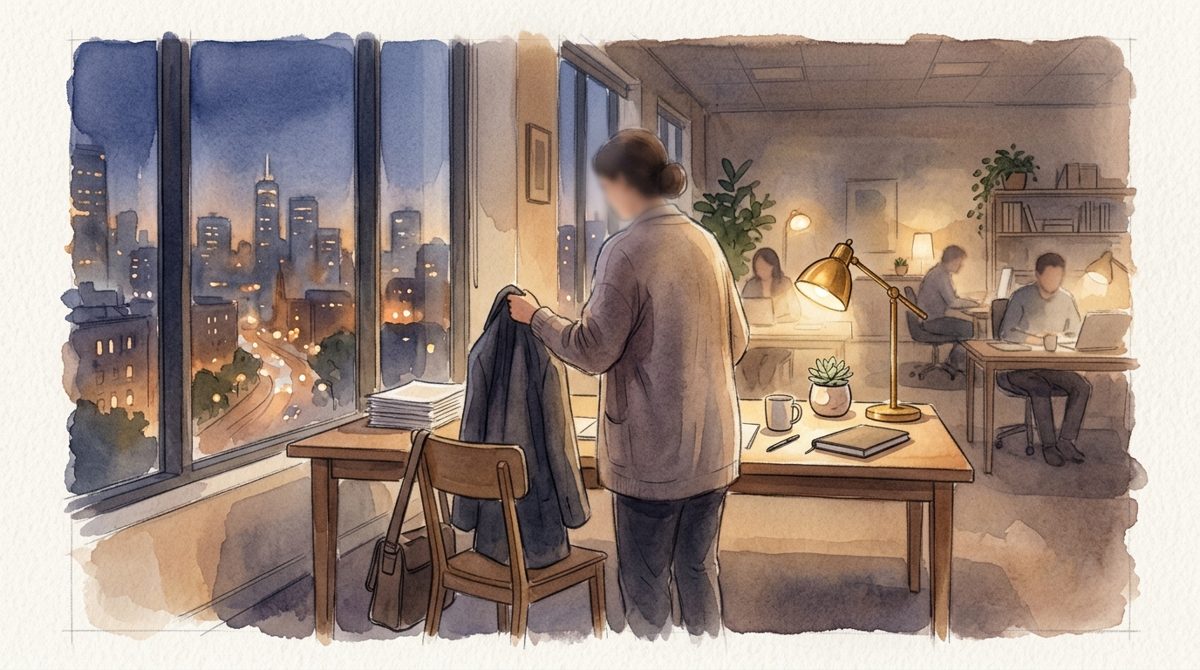
Someone in a Japanese office stands up to go home, and the people around them say the same word.
Otsukaresama (お疲れ様). Literally, something close to "you must be tired." It recognizes the other person's work and effort, and there is no one-to-one English word for it.
Coworkers say it when they part. It acknowledges the effort they shared and helps keep the group in harmony. It can take the place of "thank you," and people use it when arriving as well as leaving, which puzzles many newcomers.
I spent 37 years working at Japanese companies. I still have not found the English for it.
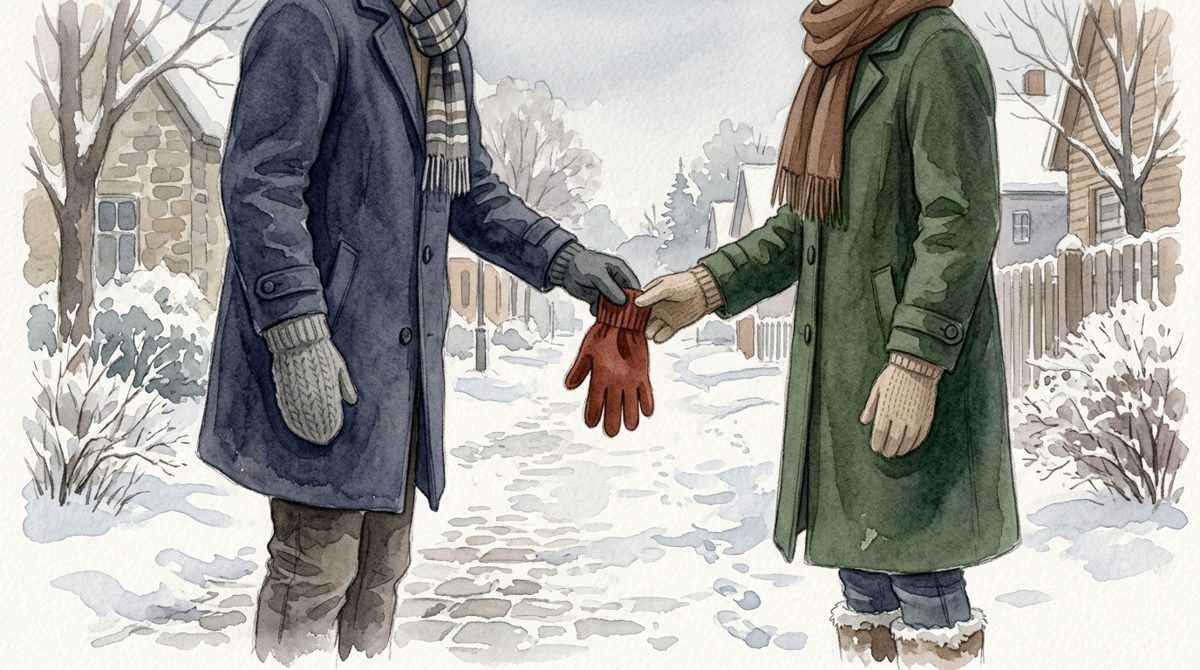
Someone in Japan hands back the glove you dropped, and you say "sumimasen." It sounds like an apology. You meant thank you.
Sumimasen (すみません) does mean "I'm sorry," but it also carries "I've put you to trouble." It comes from sumanai, "not settled." The feeling is that words alone cannot settle what was done for you.
So the thanks comes with a small apology for the effort the other person made. The same word also calls over a waiter and says sorry, which is why it confuses so many visitors.
In Japan, many of us say it several times a day without deciding which of the three we mean.
A character who snaps at you, turns away, then quietly does something kind when no one is looking. Anime fans have a word for that.
Tsundere (ツンデレ) joins two Japanese mimetic words. Tsun-tsun is cold and prickly. Dere-dere is sweet and openly affectionate.
The word is said to have appeared on Japanese online message boards around 2002, from posts about a character in the 2001 visual novel Kimi ga Nozomu Eien. The type itself is older. Urusei Yatsura (1978) is often given as an early example.
In Japan, many of us grew up with words like tsun-tsun and dere-dere. They name a mood with a sound, and the sound does most of the work.
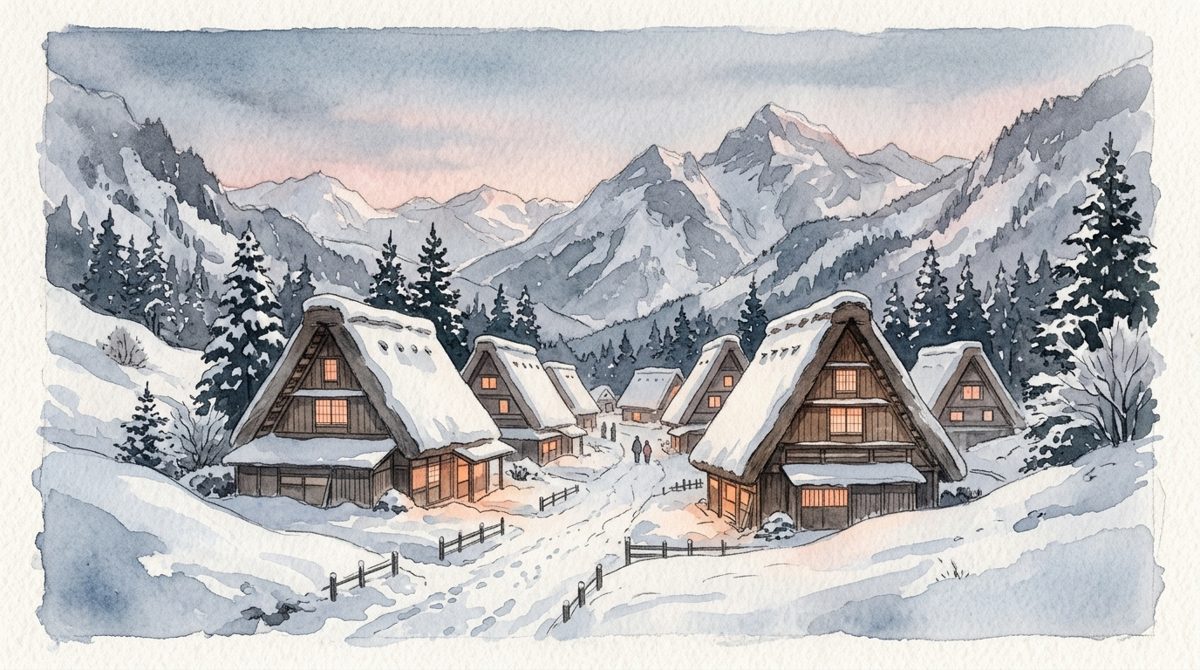
In Shirakawa-go, the roofs are so steep they nearly reach the ground. From the side, they look like two hands pressed together.
That is where the name comes from. Gasshō-zukuri (合掌造り) means roughly "built like hands joined in prayer."
The roofs slope at about 60 degrees, so heavy snow slides off. Inside, the large attic was divided into several levels and used for raising silkworms, the village's main work. Re-thatching came once every few decades, and up to about 200 villagers did it together in a single day.
Houses built in the 1700s still stand here and in Gokayama, Toyama.
In Japan, many of us make the same shape with our hands before a meal, rarely thinking of a roof.
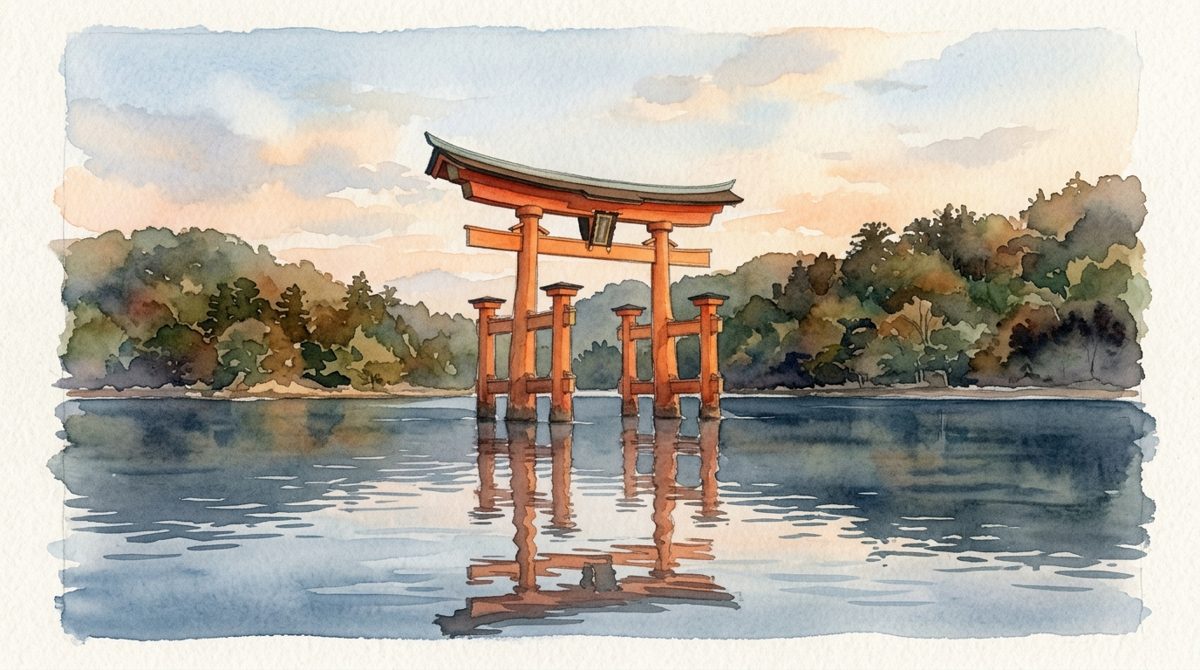
At high tide, the great gate at Miyajima seems to float on the sea. At low tide, you can walk out and stand beside it.
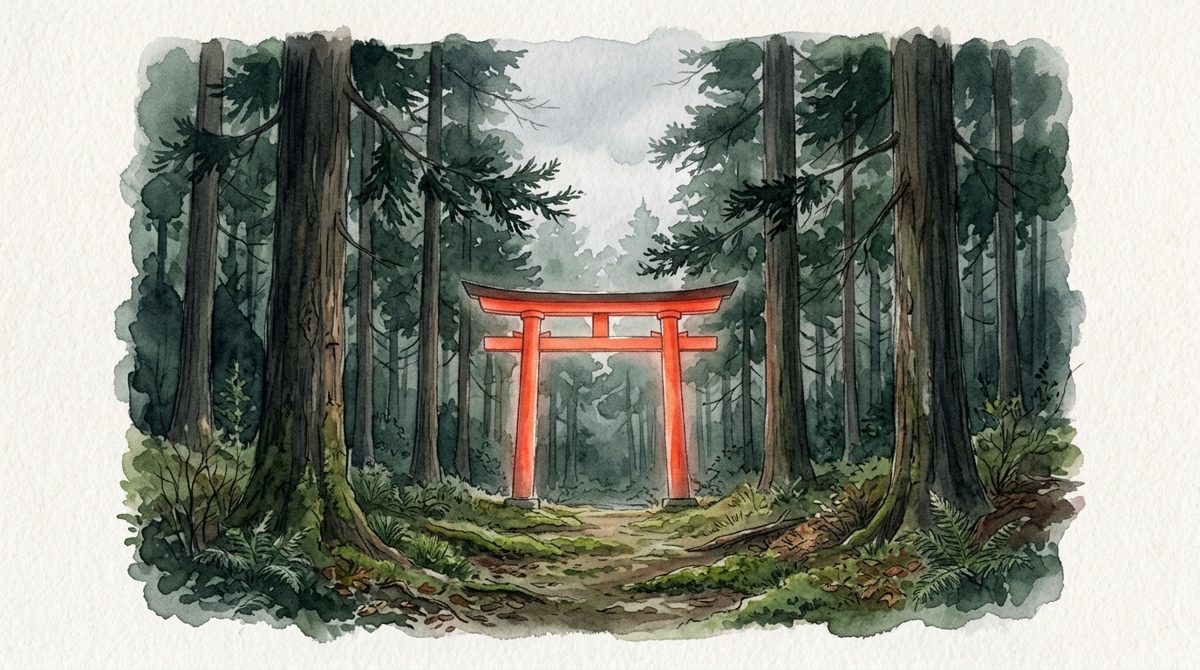
This is the torii (鳥居, shrine gate) of Itsukushima Shrine. The island itself was revered as sacred, and the shrine was built out over the water.
Shrine tradition dates its founding to 593. The gate is about 16 meters tall, and its main pillars are natural camphor trunks. The present gate was rebuilt in 1875.
In Japan, many of us know the floating gate from photos long before we ask why it stands in the sea.
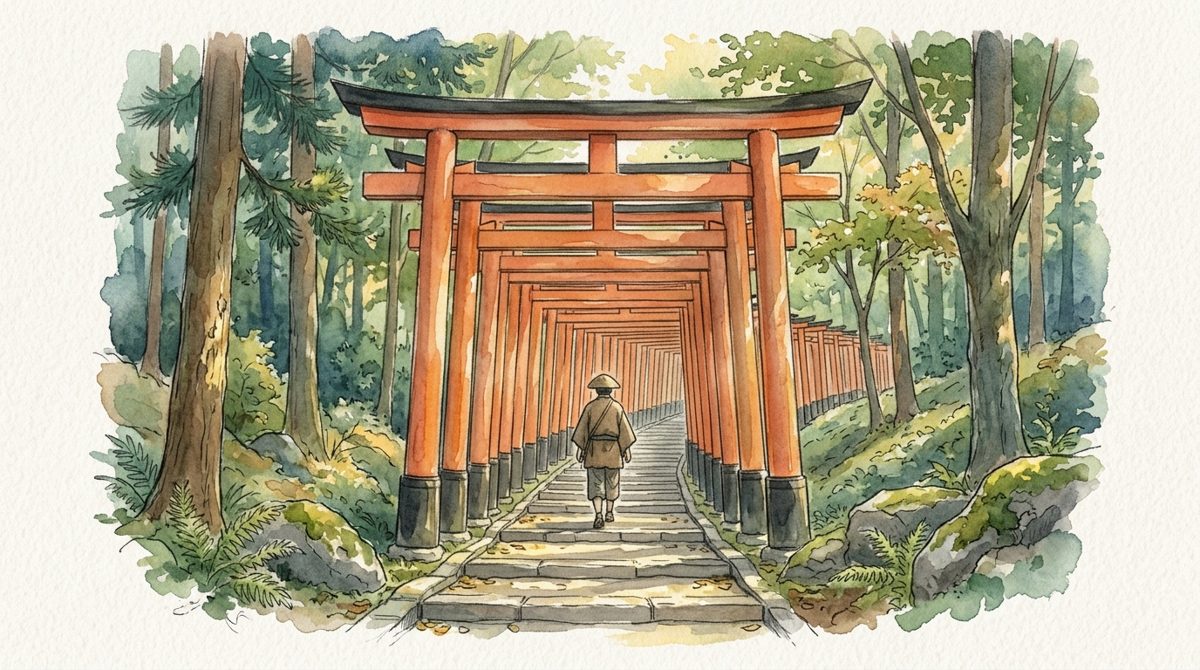
At Fushimi Inari in Kyoto, gate after gate lines the paths up the mountain. Who put them all there?
Each one is a torii (鳥居), a shrine gate. It marks the line between the everyday world and a sacred place, and walking through a tunnel of them is thought to purify you.
Most were donated by companies and merchants, with the donor's name written on the back. The custom spread in the Edo period, to ask for a wish or to give thanks when it came true. Today there are about 10,000, large and small. A new one costs roughly 175,000 to 1.3 million yen, depending on size.
In Japan, many of us walk past those names without reading them. Each one was once somebody's wish.
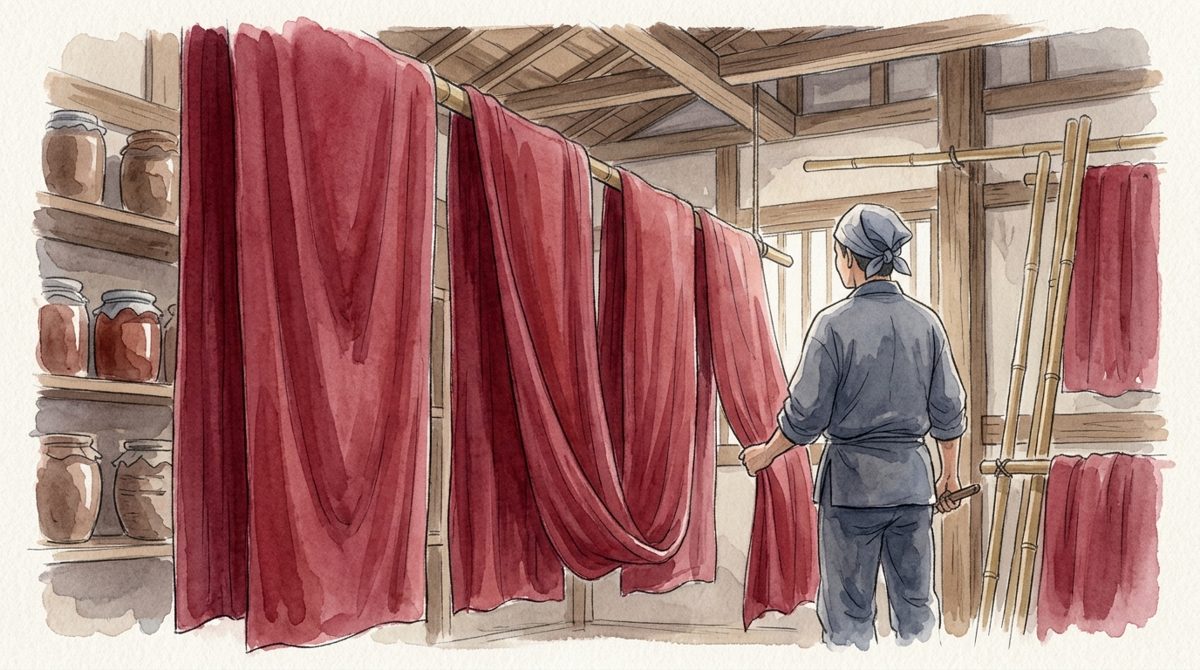
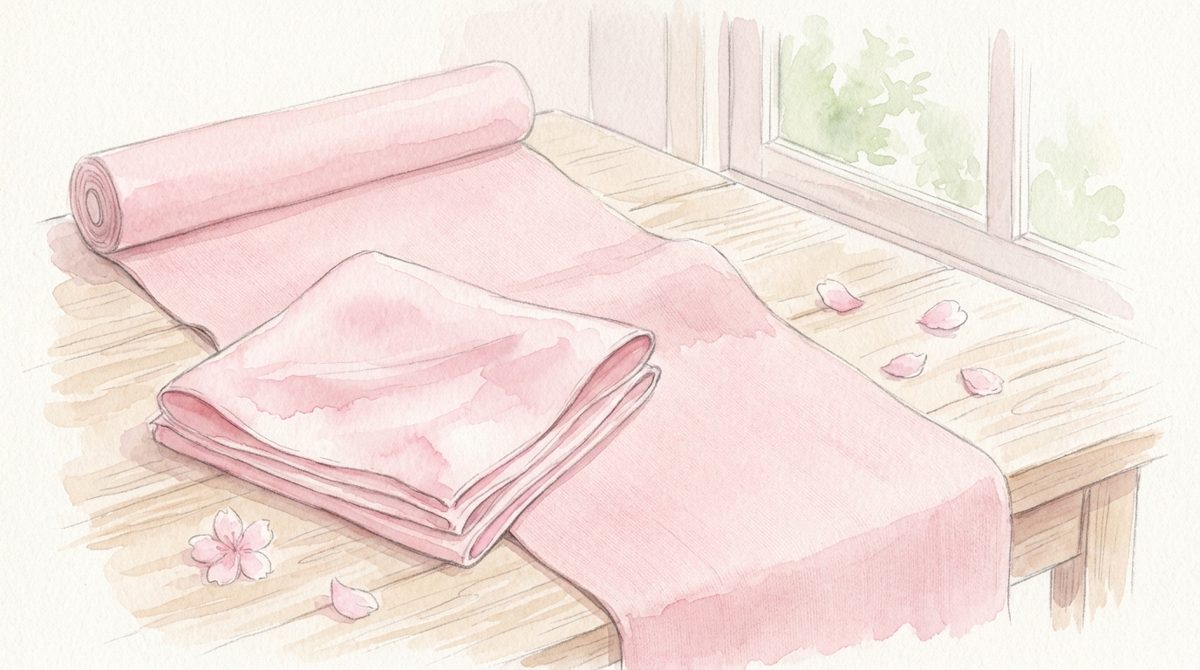
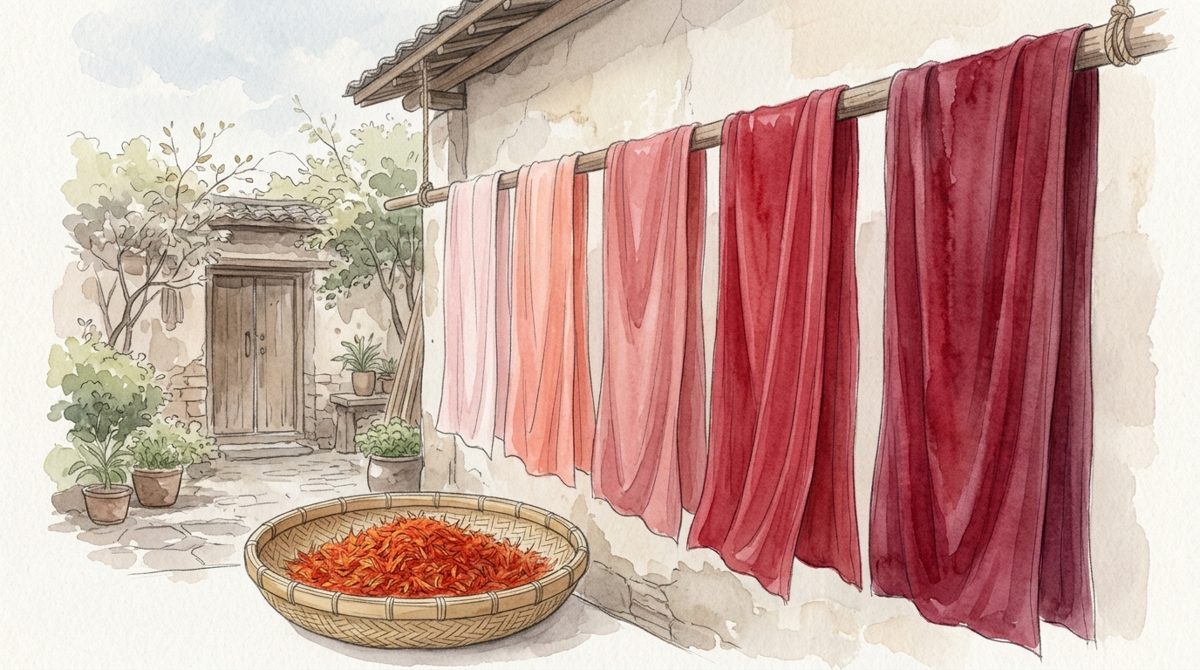
Dip silk in safflower dye once, and you get pink. To reach a deep crimson, you dip it again. And again.
That red is beni-iro (紅色), the color taken from the petals of the safflower, benibana.
The petals were first washed in water to remove a yellow dye. The red was then drawn out with lye made from ash, and neutralized with vinegar to make a clear red. Dyers also pressed the petals into small cakes called beni-mochi, which could be stored and later soaked to make the dye bath.
In Japan, many of us still call a deep red "beni," rarely thinking of the petals, or of how many times the cloth went back into the dye.
Walk up to a Japanese shrine and the gate seems to glow, even on a gray day. That orange-red has a name.
Shu-iro (朱色), usually translated as vermilion.
The name comes from a pigment once made from cinnabar, a mineral of mercury sulfide. In Japan, ground cinnabar was already being scattered in burial chambers in the Kofun period. The same name lives on in the red ink pads used with personal seals, called shuniku.
Not every red gate is painted with cinnabar, but the color itself is still called shu. In Japan, many of us press a seal into that red ink on documents without ever wondering where the color came from.
You finish your noodles at a ramen shop in Hakata, and there is still a bowl of hot soup in front of you. So you ask for more noodles. Only noodles.
That is kaedama (替え玉), roughly "a replacement ball." It is said to have started in Hakata, Fukuoka, and costs around 100 to 200 yen.
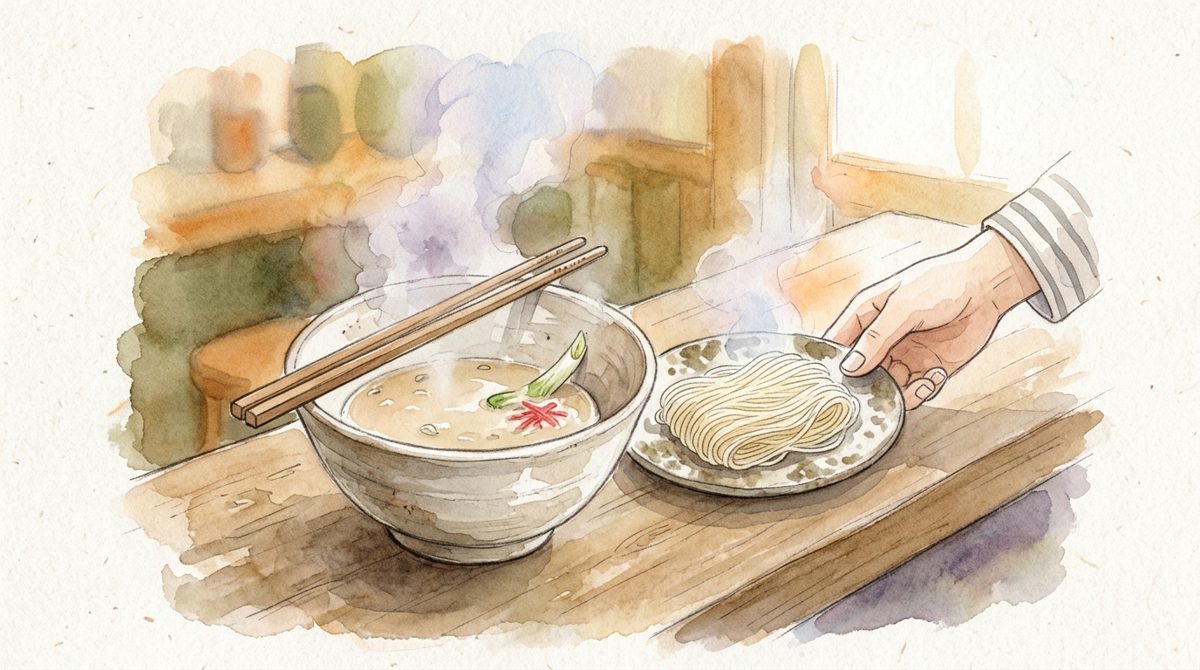
The reason is the noodles. Hakata ramen uses very thin noodles that soften quickly in hot pork-bone soup. So you finish them first, keep the soup, and order a fresh batch. Many shops let you choose the firmness with set words, such as "kata" for firm.
Go north to Sapporo and the noodles get thicker, the soup turns to miso. In Japan, many of us do not think of ramen as one dish. It changes with the town.
You meet the same friend for coffee every month. Can each of those meetings really be special?
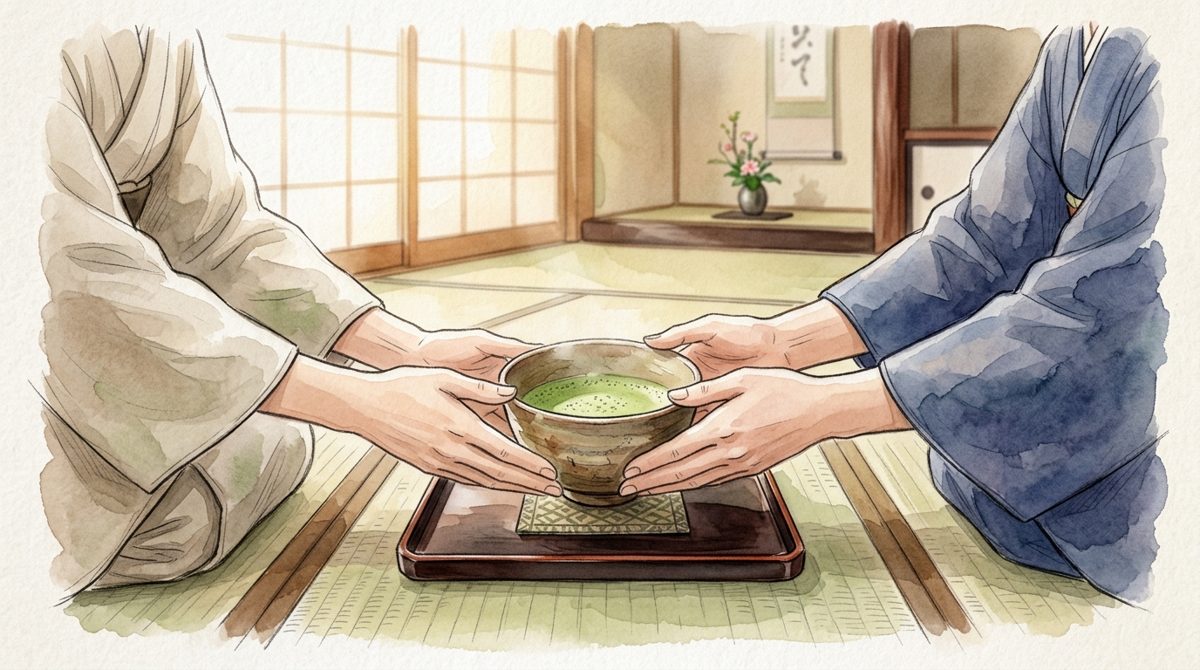
There is a Japanese phrase for this: ichigo ichie (一期一会), roughly "one time, one meeting," a meeting that happens once in a lifetime. It is known as a teaching of the tea ceremony.
The thought is that even if you meet the same person again and again, this particular hour will not come back. The phrase is linked to a famous tea master, and a later figure is said to have spread it widely.
Outside Japan, it has become a well-loved phrase for a Japanese view of life.
In Japan, many of us know the words long before we feel them. The feeling tends to arrive later in life.
Many visitors freeze at their first bowl of noodles in Japan. The people around them are slurping loudly, and no one seems to mind.
The word is susuru (すする), to slurp. In Japan, the sound is often taken as a sign that someone is enjoying the food.
There is a practical side too. Slurping cools hot noodles, and it draws air in with the noodles. For visitors used to eating quietly, the confusion is natural.
Japan is not of one mind either. At one point the word "nu-hara," noodle harassment, spread online, and people argued over whether the sound bothers other diners.
In Japan, many of us grew up slurping without a second thought. That word gave some of us a moment to pause.
Watch someone in Japan on the phone, and you may see them bow to a person who cannot see them.
The word is ojigi (お辞儀), a bow. It can mean hello, thank you, I'm sorry, or simply respect.
There is a loose guide: the deeper the bow, the deeper the respect. For many people it has become a habit the body does on its own, which is why it happens even during a call.
For visitors, the hard part is knowing when, to whom, and how deeply. Fair question.
In Japan, many of us would struggle to explain the rules out loud. The body tends to answer before the head does.
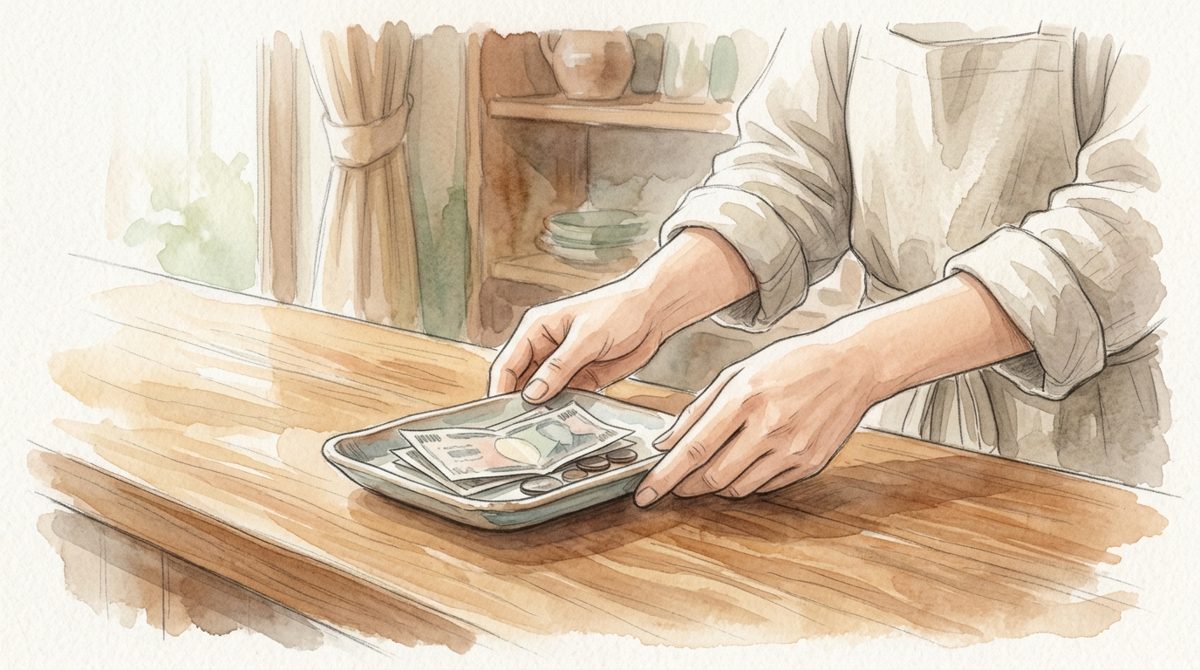
The service was perfect, so you leave a little extra money on the table. The server politely hands it back.
Many travelers in Japan have a story like this. One word behind it is omotenashi (おもてなし), roughly "wholehearted hospitality." It means sensing what a guest needs before they ask, and giving care without expecting anything in return.
The service is thought of as part of the price. A tip can even be read the wrong way, as if the service fell short, or as if you were buying special treatment. Many places simply do not accept it.
In Japan, many of us have never tipped at home. A plain "thank you" on the way out is usually enough.
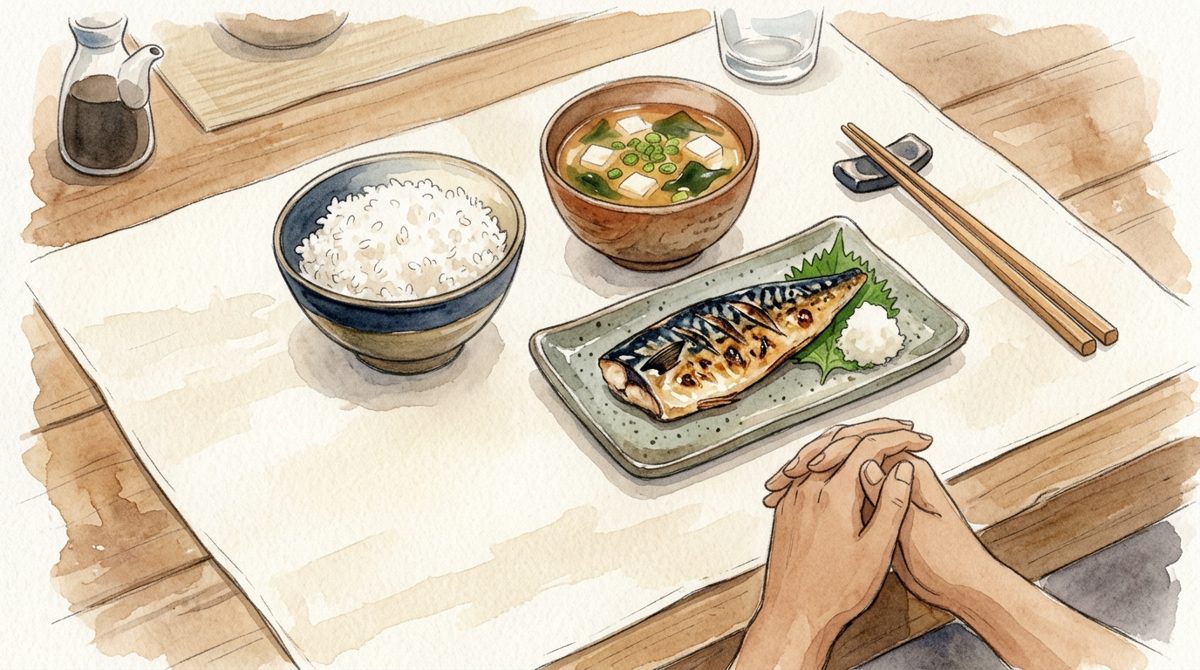
Before a meal in Japan, people pause and say one word. Visitors often wonder if it is a prayer.
The word is itadakimasu (いただきます), roughly "I humbly receive." It comes from itadaku, a humble way of saying "to receive."
The thanks goes in several directions: to the food, to the person who cooked it, to the people who grew it, and to nature. One explanation links the kanji 頂, the top of the head, to the gesture of raising something above your head as you accept it. Some say Buddhism lies in the background.
In Japan, many of us learned it at home and again at school, long before we thought about what it meant.